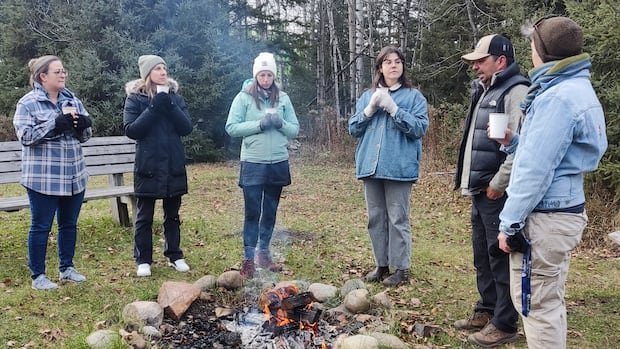


Lakehead University is testing a novel land-based educational journey that encourages individuals on campus to stroll, listen, and contemplate the profound cultural and historical importance of the land housing its Thunder Bay campus. The Etuaptmumk bimoseng, known as the Two-Eyed Seeing Walk, is a 90-minute guided exploration that merges Indigenous and Western knowledge systems. Spearheaded by Joe Duncan, an Indigenous content curriculum specialist, and Rachel Portinga, acting sustainability coordinator at the university, the walk aims to bring the university’s land acknowledgment to life in a unique manner.
Over 60 individuals, including faculty, staff, and students from various departments, have participated in the walk to date. Starting at Lake Tamblyn, the walk progresses along the McIntyre River, culminating at the campus sweat lodge. En route, participants pause at several of the 14 identified archaeological sites on the land, such as quarry sites of Jasper taconite and locations abundant in copper.
Artifacts like Jasper taconite arrowheads, copper nuggets, antler tools, and a copper knife are examined by participants during the walk. Duncan emphasizes that the journey helps individuals comprehend how deeply Indigenous peoples interacted with and learned from the land. It delves into the history of Indigenous populations in the area spanning back 9,000 years, fostering a two-eyed-seeing perspective that intertwines Western and Indigenous viewpoints.
Two-Eyed Seeing, a guiding principle that amalgamates the strengths of Indigenous and Western ways of knowing, is a focal point of the tour. Participants learn to recognize local medicines like giizhik (cedar) while also gaining insights into scientific research corroborating the plant’s detoxification and anti-inflammatory properties. Moreover, the walk addresses colonial history, including pivotal events such as the 1849 commissioners’ report, the introduction of the Indian Act in 1873, and the establishment of the residential school system.
Portinga notes that the walk’s structure illuminates the contrast between millennia of thriving Indigenous presence and the disruptions caused by colonial policies. The project’s roots trace back six years to the Office of Sustainability, expanding over time with added research, archaeological detail, and hands-on learning facilitated by Duncan, Portinga, and sustainability intern Carolina Camacho.
Anticipating future expansion beyond the pilot phase, the team envisions enriching the walk, compiling feedback, and establishing a sustainable ongoing process. Plans include developing digital and printed materials for participants, enhancing accessibility, and initiating a “train-the-trainer” program to empower more Indigenous students to lead future walks. Duncan emphasizes that the core of the project lies in connecting with the land and engaging in heartfelt dialogue, where true learning occurs outside traditional classroom settings.