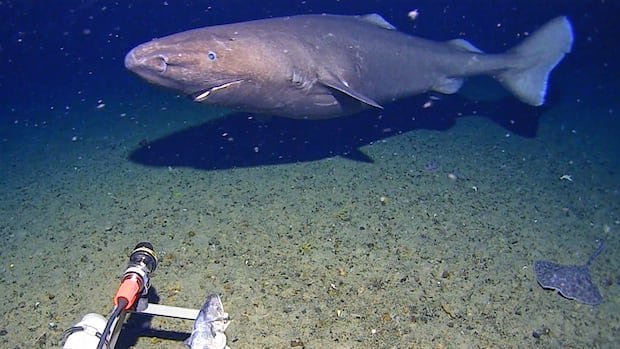


An unusual sight of a large sleeper shark slowly gliding across a desolate seabed in the dark depths of Antarctica surprised experts recently. Researcher Alan Jamieson revealed that the discovery of this shark contradicted the belief that sharks were absent in the frigid Antarctic waters. The shark, spotted in January 2025, was estimated to be between three and four meters long.
Jamieson explained that the team was not anticipating shark sightings in Antarctica due to the common assumption that sharks did not inhabit those waters. The substantial size of the shark caught on camera was described as impressive, with Jamieson referring to it as a robust and formidable creature.
The footage was captured by the Minderoo-UWA Deep-Sea Research Centre’s camera, positioned near the Antarctic Peninsula off the South Shetland Islands within the Antarctic Ocean boundaries. The video, showing the shark at a depth of 490 meters and in near-freezing temperatures of 1.27°C, was granted permission by the centre for publication.
In the video, a motionless skate, a relative of sharks resembling a stingray, was also visible on the seabed near the passing shark. Scientists had previously documented the presence of skates in that region, extending their known range to the far south.
According to Jamieson, the shark’s sighting was unprecedented in the Antarctic Ocean, with no prior recorded instances of sharks found so far south. Peter Kyne, an independent conservation biologist, echoed this sentiment, attributing the potential movement of sharks to the Southern Hemisphere’s colder waters to climate change and warming oceans.
The scarcity of data on shark populations near Antarctica due to the region’s remoteness was highlighted by Kyne, suggesting that sleeper sharks may have been present in Antarctica unnoticed for an extended period. The significance of the footage was emphasized by Kyne, describing it as a remarkable discovery.
Jamieson pointed out that the sleeper shark population in the Antarctic Ocean was likely sparse and challenging for researchers to detect. The shark, observed at a depth of approximately 500 meters along a sloping seabed, was believed to be positioned in the warmest layer of the ocean, where it could feed on deceased marine organisms.
The Antarctic Ocean’s complex stratification, extending to around 1,000 meters, was explained by conflicting water properties that prevented thorough mixing between different layers. Jamieson anticipated that other Antarctic sharks inhabited similar depths, primarily feeding on the remains of marine life that sink to the ocean floor.
Limited research cameras operating at specific depths in Antarctic waters were mentioned, with operational constraints during the Southern Hemisphere summer months from December to February. Jamieson emphasized the element of surprise in such discoveries, attributing them to the lack of continuous monitoring for the majority of the year.
This groundbreaking footage offers valuable insights into the mysterious world of Antarctic marine life, shedding light on the presence of sharks in these extreme environments.