
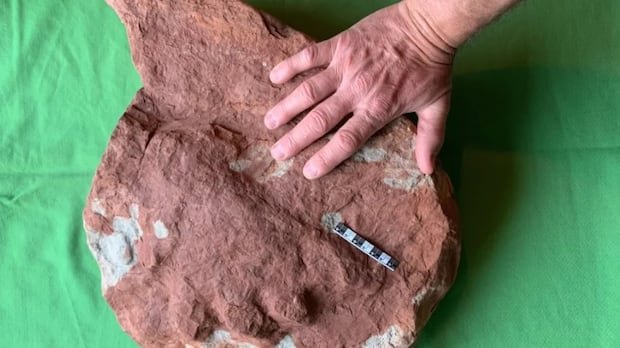


Prince Edward Island is on the brink of becoming recognized for more than just Anne of Green Gables, scenic beaches, and potato fields. A geologist from Nova Scotia, John Calder, working with the P.E.I. government to unearth fossil discoveries, has noted a surge in interest from researchers worldwide due to recent findings on the Island.
Contrary to previous beliefs that P.E.I.’s red sandstone, termed “red beds” in geological circles, did not preserve fossils well, Calder revealed that this assumption is unfounded. He emphasized the importance of actively searching for fossils, as demonstrated by the remarkable discoveries made in recent years.
The Island, once considered barren for fossils, is now gaining recognition among geologists as a significant site from Earth’s history. The increase in discoveries has largely been attributed to local Islanders like Patrick Brunet from North Rustico, who have a keen eye for recognizing fossils of importance.
Islanders will have the opportunity to view some of these fossil finds up close during Fossil Day on April 10, organized by the P.E.I. Museum and Heritage Foundation at the Charlottetown Library Learning Centre. Additionally, Calder will be sharing insights on the Island’s fossil discoveries at a Nature P.E.I. meeting on April 7.
Calder’s fascination with P.E.I. stems from its geological history, as explored in his book “Island at the Centre of the World.” He highlighted that the red rocks on the Island date back nearly 300 million years to the Permian period, a time predating the dinosaurs when reptiles were beginning to diversify.
The warm climate of that era, with rivers depositing sediments that quickly solidified, provided ideal conditions for preserving fossils. Fossils of reptiles, amphibians, insects, and even complete skeletons have been gloriously preserved in P.E.I.’s red sandstone.
Calder’s recent work has involved evaluating over 100 fossils discovered by Brunet, with many potentially forming the foundation of a permanent collection. He envisions a future where a museum on the Island will showcase these fossils, not just for academics but also for Islanders and visitors to marvel at the representations of this ancient time period.