
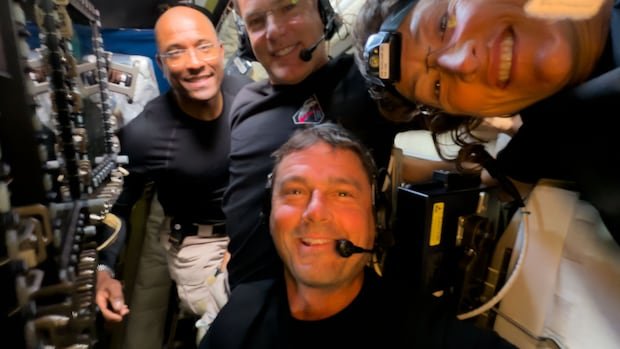

Canadian Space Agency astronaut Jeremy Hansen and NASA astronauts Reid Wiseman, Victor Glover, and Christina Koch have safely returned from a groundbreaking voyage around the moon. Setting a new record for the farthest human travel at 406,771 kilometers, surpassing Apollo 13’s 1970 record of 400,171 kilometers.
While the journey may have seemed exciting in public appearances and videos, the astronauts were engaged in scientific observations, medical experiments, and exercise throughout. This mission, known as Artemis II, served as a test for the Orion spacecraft and its functionalities.
One notable challenge faced during the mission was with the Universal Waste Management System, which encountered initial malfunctions promptly addressed by Koch. Despite subsequent issues with urine freezing in the lines, the team managed to resolve the problems, highlighting the importance of efficient waste management systems in space travel.
An emotional moment unfolded when the crew decided to name lunar craters, including one named “Carroll” in tribute to Wiseman’s late wife. This gesture underscored the human aspect of the mission, demonstrating camaraderie and respect among the team members.
The mission was also marked by significant scientific endeavors, including health experiments and spacecraft evaluations. The astronauts conducted a lunar flyby, providing detailed observations of lunar features to mission control using both cameras and visual observations.
A surprising highlight was witnessing meteoroids impacting the lunar surface, a rare occurrence that delighted the team and scientists on Earth. The data collected during the mission will be thoroughly analyzed over the coming months to enhance future space missions.
Looking ahead, NASA is gearing up for the Artemis III mission in 2027, which will serve as a test mission with a lunar lander provided by Blue Origin or SpaceX in Earth orbit. Subsequent missions, such as Artemis IV in 2028, aim to return humans to the lunar surface, marking significant milestones in space exploration.