
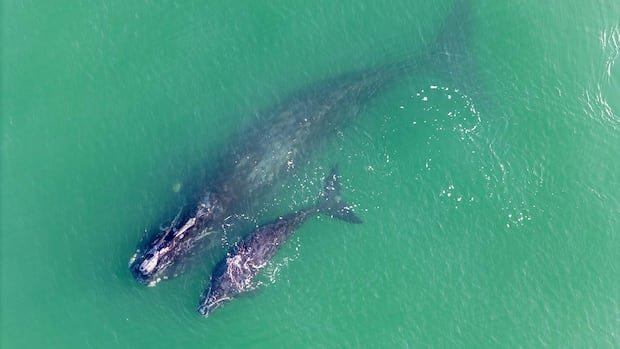

North Atlantic right whale experts on both sides of the border express cautious optimism following an increase in the number of new calves born this year. The calving season from November to April off the southeastern U.S. saw the birth of twenty-three calves, the highest count since 2009.
Amy Warren, a scientific program officer at the New England Aquarium’s Anderson Cabot Center for Ocean Life, remarked on the positive development, stating that while the twenty-three calves are a hopeful sign, their survival into adulthood is crucial for population growth. The North Atlantic right whales are critically endangered, with only 380 remaining globally, as estimated in 2024.
In the past two to three decades, approximately 20 new calves were born each year. However, this number has dwindled over the last decade, with averages closer to 10 to 15 calves annually. The absence of known calves born in 2018 underscored the declining trend. Warren emphasized the need for sustained positive trends to counterbalance the years of low calving numbers.
The health of the mothers plays a significant role in calving success, with factors such as food availability impacting their ability to sustain themselves during the calving and nursing periods. The North Atlantic right whales rely on specific plankton species for sustenance, but climate change has disrupted their food sources, forcing them to travel farther north in search of food.
Various human-induced stressors, such as ocean noise, vessel traffic, and entanglements in fishing gear, also pose threats to the whales’ well-being. Conservation efforts in Canadian and U.S. waters, including fishery closures and speed restrictions for marine vessels, aim to mitigate these risks.
Notably, this year saw not only an increase in the number of calves but also a shorter gap between consecutive births for some mother whales, indicating improved reproductive health. Researchers view this trend positively, as it suggests a potential acceleration in population growth.
While the recent baby boom among North Atlantic right whales is seen as encouraging, experts caution that sustained high calving rates, with around 50 calves per year for several years, are needed to reverse the population decline. The whales have been observed moving northward, with sightings in the Gulf of St. Lawrence for the first time this year, indicating a shift in their migratory patterns.
The positive developments in the North Atlantic right whale population offer hope for the species’ future, but continued efforts and monitoring are essential to ensure their long-term survival and recovery.