
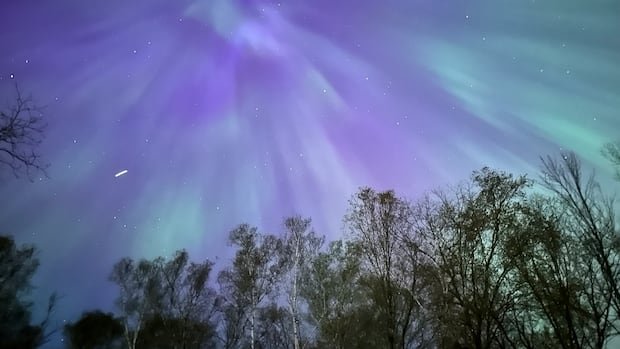

On Monday night, there is a chance to witness a spectacular display of the northern lights if the skies are clear. The U.S. Space Weather Prediction Center reported that a powerful X 1.9 solar flare, followed by a coronal mass ejection (CME), was released by the sun. These X flares are among the most potent on the solar flare scale.
What made this particular flare noteworthy was its prolonged duration, lasting for several hours, which increased its intensity beyond a typical flare of similar magnitude. CMEs are massive eruptions of solar particles that travel swiftly on the solar wind. When these particles interact with Earth’s magnetic field, they can create dazzling northern lights, also known as the aurora borealis (or aurora australis in the southern hemisphere).
Luckily, Earth happened to be in the trajectory of the CME, promising a fantastic opportunity for northern lights enthusiasts. The SWPC forecasts that the CME is expected to reach Earth between late January 19 and early January 20 EST.
Geomagnetic storms, which disturb Earth’s magnetosphere, are rated on a scale from G1 (minor) to G5 (extreme). The SWPC anticipates a severe G4 storm, which could lead to stunning visual displays. For reference, the geomagnetic storms in May 2024 and October 2024, which caused remarkable light shows even in the Caribbean, were classified as G5 events.
The aurora borealis is typically visible in northern regions, but under favorable conditions such as Earth intercepting a CME’s particle stream, they can be seen even further south. To observe them, the auroral hole through which CME particles travel must dip southward. The more it dips, the more southern sightings are possible. Additionally, visibility is enhanced when the storm coincides with nighttime.
While this time of year may not be optimal due to increased cloud cover, enthusiasts can improve their chances by heading to dark, cloud-free locations. Given the severity of the forecast, it may not be necessary to face north to witness the spectacle, although it could aid visibility in case of a moderate storm.
To track the visibility of the aurora borealis in your area, consider using apps like Aurora Alerts and Aurora Forecast.