
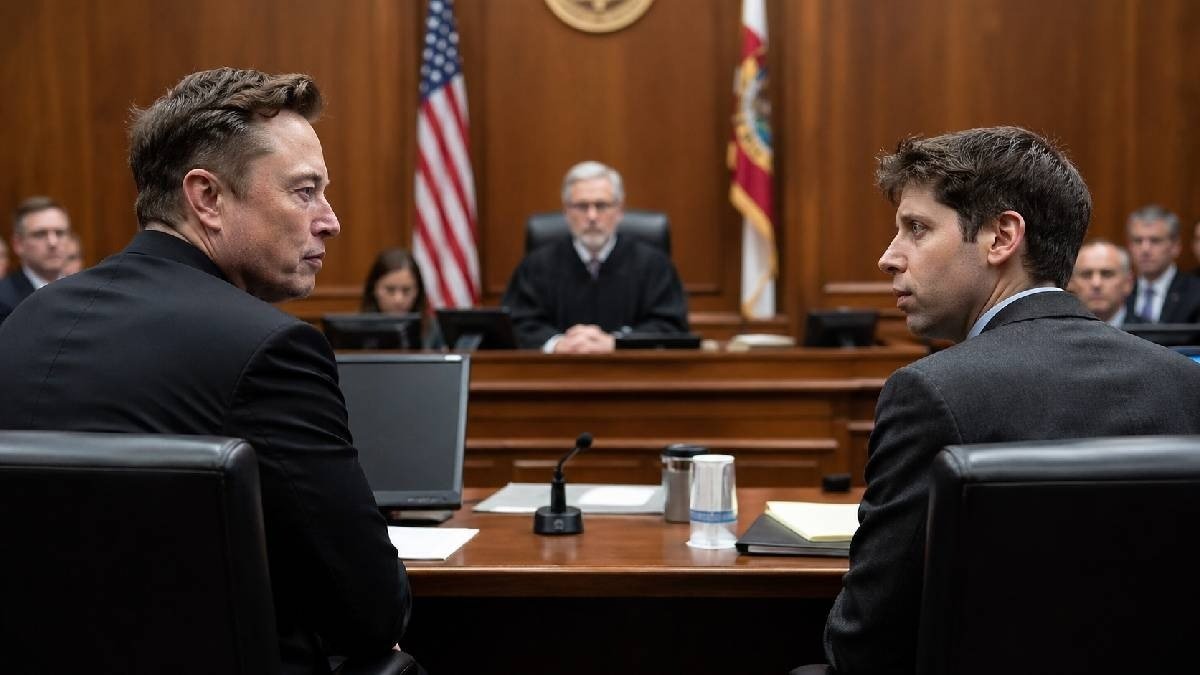

The highly awaited legal battle involving Elon Musk and Sam Altman has completed its initial day of testimony, primarily focusing on Musk’s account of OpenAI’s inception. Musk has accused OpenAI CEO Sam Altman and co-founder Greg Brockman of deviating from the original mission to keep the artificial intelligence lab a nonprofit. This trial has the potential to impact OpenAI’s organizational framework, funding sources, and partnerships, including its relationship with Microsoft. The trial commenced with jury selection on Monday (US time), with Elon Musk being the first witness on Tuesday.
Regarding the origins of OpenAI, Elon Musk’s legal representative informed the court that Musk has been concerned about the notion of machines surpassing human intelligence since his college years. Despite his efforts to advocate for government regulation of advanced AI, Musk felt that little concrete action was taken. During that period, Musk collaborated with Sam Altman to establish OpenAI as a nonprofit entity. Their motivation stemmed from apprehension over Google’s rapid advancements in AI and a shared desire to develop a more secure alternative.
Musk expressed that the establishment of OpenAI was in response to being labeled a “speciesist” by Larry Page, a co-founder of Google. Musk aimed for OpenAI to serve as a contrasting model to Google, emphasizing an open-source nonprofit approach. As OpenAI expanded, Musk and Altman agreed to establish a for-profit division to secure substantial funding required for development. Musk endorsed this decision as long as the nonprofit entity retained control.
However, Musk later became disenchanted with the direction taken after Microsoft’s $10 billion investment in 2023, observing a shift of resources and talent towards the for-profit sector. Drawing an analogy, Musk’s attorney likened the situation to a museum selling valuable artworks and concealing them from public view.
In response, OpenAI’s lawyer contended that the company never made a commitment to Musk regarding the nonprofit status or complete public disclosure of its code. He argued that Musk’s assertions lacked substantiating evidence. The lawyer highlighted Musk’s awareness since 2018 of OpenAI’s intention to secure over $10 billion in corporate funding, citing Musk’s prior concerns about Microsoft’s involvement in a 2020 tweet. The lawsuit was only filed by Musk after launching his own AI company, xAI, in 2023.
OpenAI’s stance was that Musk did not fulfill his financial commitments, having pledged up to $1 billion but contributing only around $38 million over five years. The company also asserted that Musk aimed to exert control over OpenAI through himself or Tesla, a proposition that was rejected. OpenAI contended that Musk departed after the company declined to integrate into his broader business network, while Musk maintained that he sought temporary control to steer its direction.
Tensions spilled into the courtroom over social media exchanges, with OpenAI questioning Musk’s derogatory post referring to Sam Altman as “Scam Altman.” Musk defended his actions as responses to previous posts from OpenAI. The judge urged both parties to desist from escalating matters online, leading to a mutual agreement between Musk and Altman to refrain from social media activity during the trial.
The article concludes with an emphasis on the ongoing legal dispute between Musk, Altman, and OpenAI, showcasing the complexities and conflicting perspectives surrounding the case.