
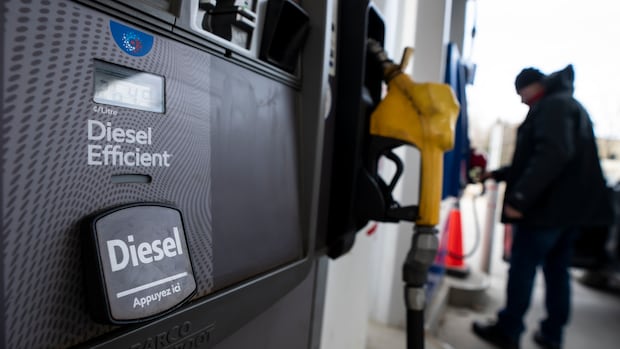

As diesel prices surge due to ongoing global conflicts, experts warn that the cost of fueling trucks transporting food and goods across Canada has reached unprecedented levels, which may soon impact Canadians.
Tej Dulat, director of government and public affairs at the Canada Truck Operators Association, shared his concerns with CBC News, stating, “It’s very bad.”
According to Dulat, commercial trucks consume hundreds of litres of diesel weekly, making fuel one of the largest expenses for trucking firms. While the industry typically manages to endure temporary price hikes, he noted that profit margins have become tighter since prices spiked in 2022, following Russia’s invasion of Ukraine.
Currently, diesel prices are even steeper.
“Ultimately, businesses will have to transfer that cost onto consumers,” Dulat remarked.
“You will notice that effect in grocery prices.”
As of Saturday, diesel prices in Canada averaged $2.62 per litre, eclipsing last week’s peak of $2.52 after a temporary decrease earlier this week. This marks an increase of over a dollar compared to the same time last year, as reported by Natural Resources Canada, and exceeds the 2022 weekly average high of $2.30.
In certain areas, the situation is even more dire; Vancouver’s price reached $2.92 per litre on Saturday. Meanwhile, in the U.S., diesel prices soared to a record-high of more than $6 US per gallon on Friday, creating considerable concern nationwide.
While recent weeks have focused on the possible effects of tariffs on Canadian products, experts indicate that the surge in oil prices suggests that geopolitical tensions are currently exerting a more significant influence.

Industries reliant on diesel are also facing the repercussions of elevated oil prices. In Alberta, some farmers report that diesel prices are 80 cents higher per litre than last year, severely affecting their profits.
Last week, Bank of Canada Governor Tiff Macklem noted that while tariffs could severely impact certain sectors, they do not predict a significant effect on the overall economic activity in Canada.
However, the ongoing conflict between the U.S. and Iran, a key factor in maintaining high gas prices, could lead to increased costs for other goods in the near future, he stated.
“The longer oil and refinery prices remain elevated, the higher the risk that increased energy costs will lead to persistent inflation.”
-
Who are the Houthis? How they could send oil prices surging even further
-
Renewed U.S.-Iran exchanges send oil price back over $100 US for first time in several weeks
Insufficient supply
Experts indicate that diesel supply is currently critically low. Net diesel/gasoil exports from the Persian Gulf region fell to just over a quarter of pre-war levels as of August, according to a report released on Friday by the International Energy Agency.
Additionally, other geopolitical tensions are exacerbating the diesel supply issues. Russia, one of the largest producers of diesel, recently prolonged a ban on diesel exports after damage was inflicted on several oil refineries in Ukraine.
Canada’s largest refinery, the Irving Refinery in New Brunswick, is also undergoing maintenance until November, which includes upgrades that affect diesel production.
Recently, the federal government announced that the temporary suspension of the federal fuel excise tax, including a four-cent per litre tax on diesel, would be extended through January 2027 instead of ending on September 7.
However, experts believe this measure does not sufficiently alleviate costs.
Patrick De Haan, head of petroleum analysis at Gas Buddy, warned CBC News, “This could become a hidden threat to the North American economy if not addressed within the coming months.”

In Nunavut, the hamlet of Igloolik is running critically low on fuel, raising concerns about the potential impact on essential services. Arty Sarkisian reports.
Despite ongoing conflict between the U.S. and Iran since a brief agreement fell apart in June, Iranian officials announced on Friday that they would meet with Iraq and other nations around the Persian Gulf in Oman on Monday to discuss secure commercial shipping routes in the Strait of Hormuz.
Are Canadians facing an expensive winter?
Historically, diesel prices tend to rise even higher during the winter months, according to energy analyst Dan McTeague, suggesting that “we could be facing an extremely costly winter ahead, not just for the trucking and transport sectors, but also for airlines, trains, and consumers.”
Canadians are concerned, as any increase in diesel prices affects every segment of the food supply chain: from shipping to storage and production, explains Evan Fraser from the University of Guelph’s Arrell Food Institute.
There is usually a significant delay between a rise in diesel prices and its reflection on grocery store shelves, and while some effects may diffuse, Fraser anticipates that this time may differ.
This is attributed to multiple factors at play, including heat waves impacting harvests.
“We are experiencing a perfect storm of issues exerting continuous upward pressure on food prices.”

Any increase in diesel prices directly affects the entire food supply chain: from shipping to storage and production, as noted by Evan Fraser at the University of Guelph. (Chris Young/The Canadian Press)
Fraser expresses concern that Canadians might have to adapt to a “new normal” of persistently high food prices over the next decade, as the reliable conditions for global food production and trade—such as low and stable energy prices, a conducive environment for agriculture, and favorable geopolitical relations—are no longer guaranteed.
“In the short term, this will pose significant challenges for low-income Canadians.”