
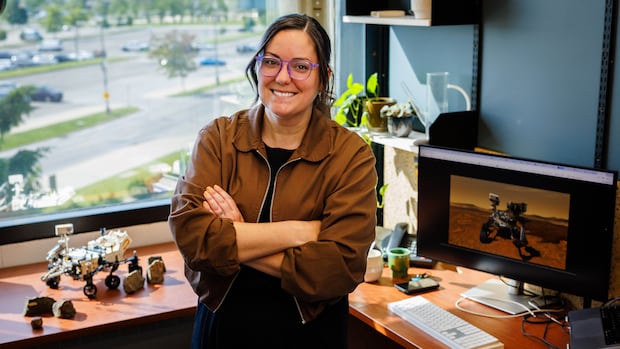

Inside an ancient meteorite, estimated to be 4.4 billion years old, are potential insights into the history of Mars.
This meteorite, referred to as NWA 8171, holds a mineral that has not previously been identified in Martian specimens. It may provide important information regarding the formation of the planet.
“The most thrilling aspect is that we may have discovered a new rock type from Mars,” stated Tanya Kizovski, an assistant professor in the earth sciences department at Brock University, who made the find.
“We are broadening our understanding of geological possibilities.”
Discovery Details
NWA 8171 was initially found in 2013 and is among at least 18 fragments that entered the atmosphere as a single rock and subsequently shattered. The pieces landed on Earth, where they were collected and recognized as being from the same meteorite.
Currently, it is housed in the Royal Ontario Museum in Toronto, where Kizovski had the opportunity to study it.
This specimen is categorized as breccia—a type of sedimentary rock composed of fragments from other rocks—providing valuable insights into Mars’ geological past. Kizovski described it as “the ideal starting point” due to its age and the variety of rock types it contains.
Within the breccia, Kizovski discovered garnet.
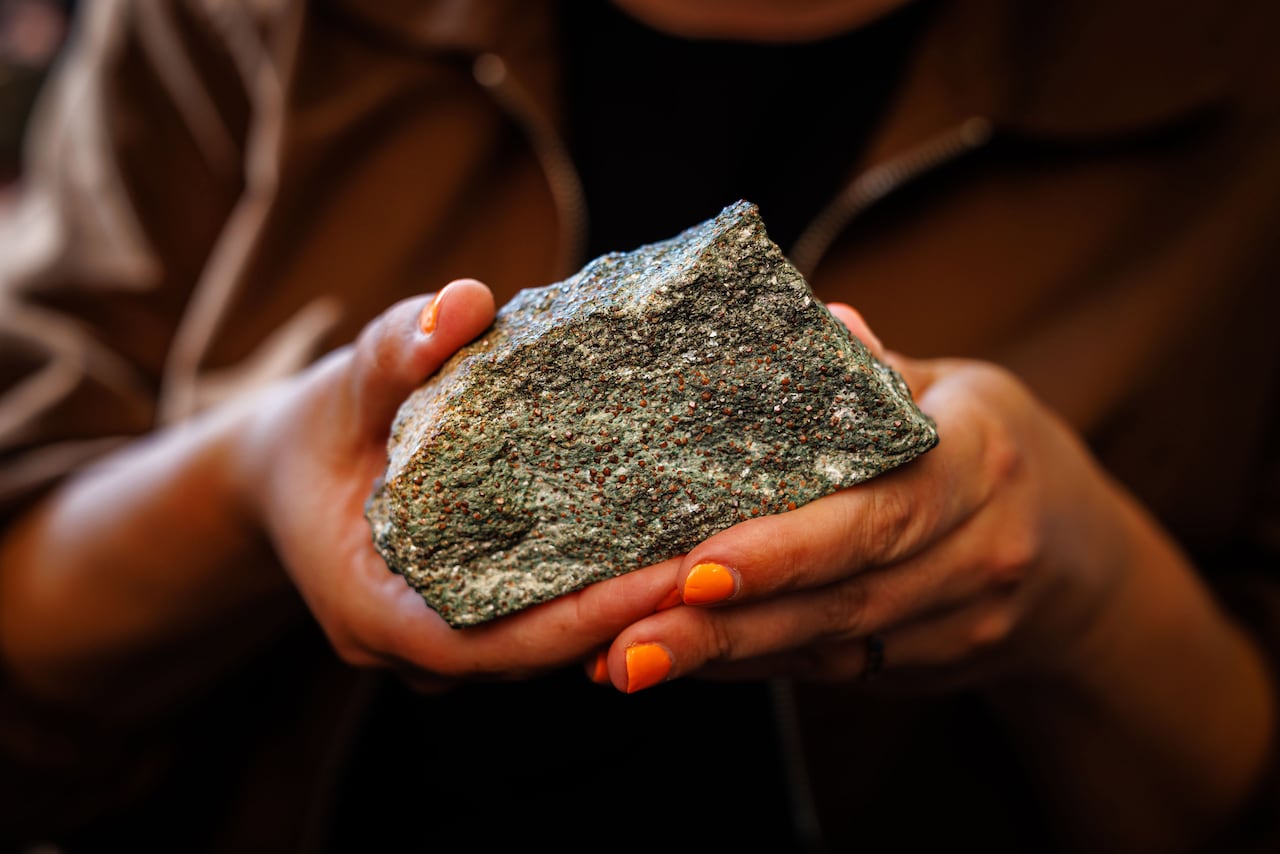
Kizovski displays a rock known as eclogite, a garnet-bearing rock from Earth featuring red garnets and green pyroxene. (Submitted by Stephen Leithwood)
While red garnet stones are commonly utilized in jewelry and represent January’s birthstone, the type found here is specifically known as andradite and can appear in various colors. Kizovski noted that the garnet in NWA 8171 is “definitely dark-hued,” but it is difficult to determine if it is green or yellow.
New Planetary Insights
Chris Herd, who completed his PhD focusing on Martian meteorites, referred to this breccia as “one of the most important findings in Martian meteorite research in the past 15 years.”
He believes it can shed light on the various geological processes of the planet.
“Garnet is not something we typically observe or have encountered before. We certainly haven’t seen it in Martian meteorites until now,” remarked Herd, a professor at the University of Alberta.
“This challenges us to consider the processes and conditions that might have existed on or within Mars, which could have led to the formation of this small rock fragment.”
Herd expressed that there is a chance of discovering more garnet in the remaining fragments, which could enhance researchers’ understanding of this finding.
Origin of the Garnet
Although Kizovski has identified garnet in a Martian meteorite for the first time, she cautions that the origin of the mineral remains unclear.
“Numerous meteorites have struck Mars throughout its history,” she remarked. “So, it is possible that this piece is a remnant of one of those meteorites that impacted Mars.”
To determine if the garnet is indeed Martian, scientists would need to analyze a portion of the sample to check its isotopic signature and see if it corresponds with that of Mars. An isotopic signature indicates the atomic structure of a substance, helping scientists trace its geographic origin or historical background.
Thus, the initial plan is to conduct extensive studies on it.

A meteorite discovered in the Moroccan desert is recognized as the only known fragment of Martian crust found on Earth.
Despite the uncertainties, Kizovski asserts that it contributes crucial information about the planet—another piece in the puzzle of deciphering Mars’ geological and climatic history.
Little is understood about whether Mars possesses plate tectonics—the scientific principle that explains the gradual development of continents over billions of years on Earth—but Kizovski suggests this discovery could pave the way for further exploration.
“What excites me the most is the prospect of revisiting some of the data we have collected from rovers and orbiters and potentially uncovering evidence of this rock type in areas we haven’t previously examined,” Kizovski expressed.
“There are many fascinating paths to explore, and I am eager to continue this journey.”