


Leaders of the Alberta separatist movement are planning to begin canvassing in January in order to place their independence referendum question on the ballot, facilitated by recent legislation from the provincial government aimed at easing their efforts.
If not for the rapid approval of Bill 14 by the United Conservatives this week, the Alberta Prosperity Project’s citizens initiative would have faced significant challenges due to a judicial decision stating that the current initiative law did not allow for a referendum on independence.
The new legislation revitalizes the separatists’ initiative by eliminating the requirement for Elections Alberta, or any other entity, to assess the constitutional validity of a proposed question.
Moreover, Bill 14 compelled Elections Alberta to recognize that the previous proposal for a question was never formally submitted, rendering the court’s ruling irrelevant and allowing the independence group to reapply immediately for their petition drive to be reassessed, free from the obstacles that hindered their initial attempt.
In light of this, APP leader Mitch Sylvestre, accompanied by an attorney, visited Elections Alberta on Thursday to submit their new application for evaluation. Their organization praised the government’s supportive legislation that made this progress possible.
“Bill 14 receives royal assent — Alberta’s sovereignty era begins!” proclaimed a jubilant post on the APP website.
To a prominent critic of the separatist agenda, this development indicates Premier Danielle Smith’s submissiveness to the radical elements within her party’s base.
“The Premier is going to great lengths to enable this separation referendum,” stated former Tory deputy premier Thomas Lukaszuk, who led the successful Alberta Forever Canada petition that sought a referendum asking Albertans if they wished to remain in Canada — opposing the separation question.
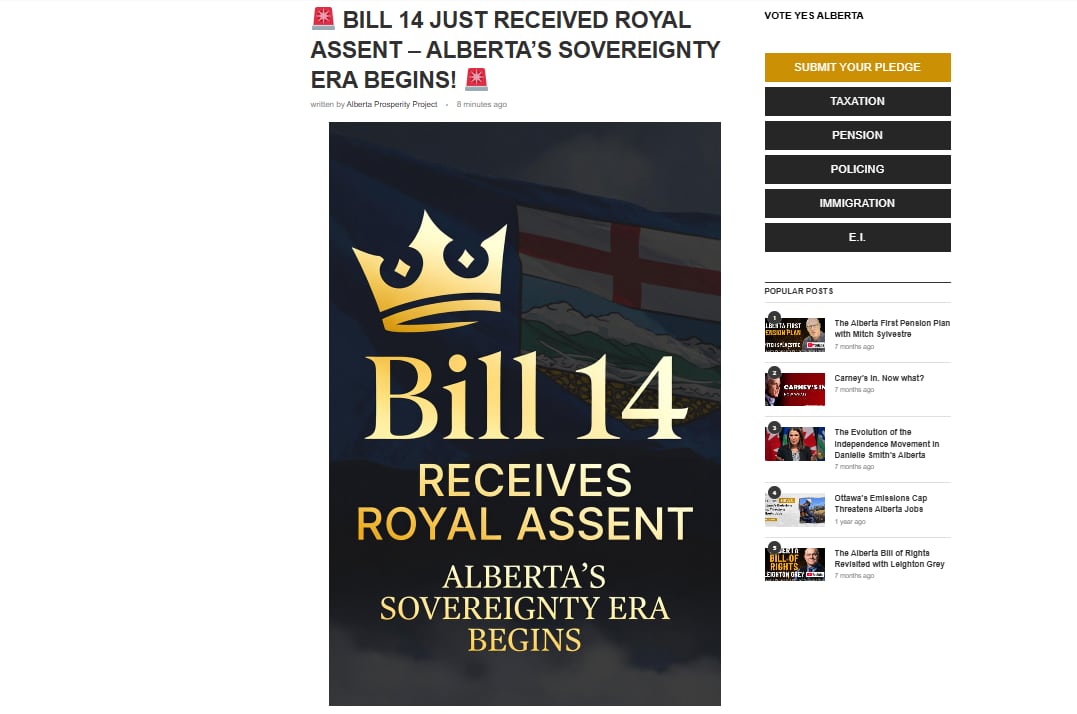
The Alberta Prosperity Project celebrated the bill that gave their separatism referendum initiative a much stronger chance of succeeding.
(Alberta Prosperity Project)
While the United Conservatives and their leadership continue to officially advocate for a unified Canada, they have enacted two pieces of legislation that facilitate supporters of a divided Canada in their push for a separation referendum in Alberta.
Eight months prior to Bill 14, the UCP government introduced legislation that significantly reduced the threshold for petitioners to compel a constitutional referendum, lowering the requirement from approximately 600,000 signatures to about two-thirds less.
“The initial significant change came from the amendments to the Citizen’s Initiative Act, which reduced the number of required signatures to 177,000,” Sylvestre shared in an interview with CBC News on Friday.
Provided that the new application from APP meets the now-lowered criteria, Elections Alberta is expected to approve its question by early January, paving the way for a four-month petition campaign to gather sufficient signatures shortly thereafter, according to Sylvestre.
This implies canvassing during the harsh Alberta winter; however, APP’s leadership indicated that finding supporters should not be overly difficult. This is because, by spring, around 250,000 individuals had registered on their website, all expressing their intent to sign the in-person petitions.
Additionally, APP has enlisted 1,900 canvassers, with half of them already trained, Sylvestre noted, after hosting numerous pro-independence events throughout the province in both urban and rural areas over the past year.
In contrast, Lukaszuk’s Forever Canada petition had 6,500 registered petition gatherers, as he informed CBC News.
His pro-Canada campaign attracted significantly more signatures than the 293,000 needed under the former regulations. More than 438,000 Albertans signed it, according to Elections Alberta, representing nearly one in seven of all eligible voters in the province.
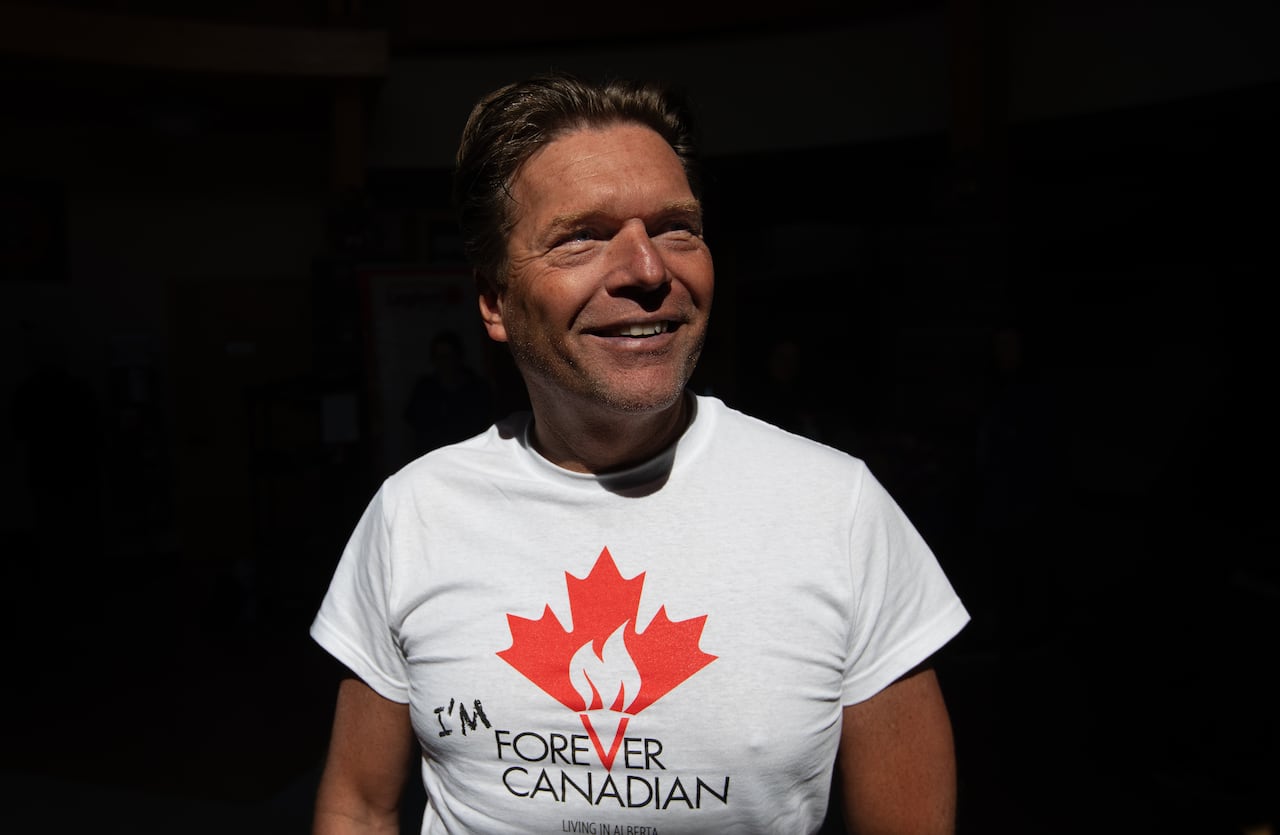
Thomas Lukaszuk, former deputy premier and organizer of the Forever Canadian petition. (Jason Franson/The Canadian Press)
Under the new, lowered requirements set by the Smith government, the separatist organization needs fewer than one in 16 eligible Albertans to sign their petitions.
The legislative relief granted to APP also enabled the group to slightly modify the wording of their proposed referendum question. When Sylvestre applied earlier this year, the question was: “Do you agree that Alberta shall become a sovereign country and cease to be a province in Canada?”
Now, it reads: “Do you agree that the province of Alberta should cease to be part of Canada to become an independent state?” APP adjusted the wording, Sylvestre explained, to align precisely with the language outlined in the Clarity Act, a federal law established after Quebec’s narrowly failed separation vote in 1995, intended to clarify the legal framework surrounding a province’s departure from Canada.
Although officials from the Alberta government were hesitant to acknowledge that their spring legislation was specifically designed for the active separatist movement within the UCP, this reticence was not evident with the more recent Bill 14.
“If those advocating for independence believe they have sufficient support, this is their opportunity to demonstrate it,” Justice Minister Mickey Amery stated to reporters when he introduced the bill on December 4. Six days later, the UCP-majority legislature approved it on the assembly’s last meeting day of 2025, and the lieutenant-governor enacted the bill into law the following day.
Sylvestre expressed gratitude for Amery’s subsequent legislation in support of his cause.
“What they are meant to do is empower citizens to question the government without any restrictions,” he remarked.
(While Bill 14’s provisions appeared aimed at the separatist petition, its reach also impacted musician Corb Lund’s recently approved attempt to compel a referendum on banning new coal mining on the eastern slopes of the Rockies. Lund described the reversal of his petition’s approval as “disappointing and fundamentally unfair,” but he pledged to reapply.)
While separatists are optimistic that Albertans will have the opportunity to vote “Yes” for independence in the upcoming fall, it remains uncertain how the Smith government will first respond to the Forever Canada petition that seeks a “Yes” to remain.
This petition is currently under review by an MLA committee. Although Lukaszuk’s petition called for a non-constitutional referendum, he has since indicated that his aim is for the question to be addressed in the legislature, rather than among the general public — to compel United Conservative MLAs to reveal their positions on this contentious issue.
APP’s commendation comes less than two weeks after Jeffrey Rath, the group’s legal advisor, received a standing ovation from a hall full of Smith’s party supporters for his brief pro-independence address at the UCP convention.
During that event, many attendees booed Smith during her remarks about a recent pipeline agreement with Ottawa, which she claimed demonstrated Canada’s effectiveness, and when she endorsed the notion of a sovereign Alberta existing within a united Canada.
Leading party officials and polling data indicate that a majority of UCP supporters favor Alberta’s separation, despite the notion remaining largely unpopular among the wider public.
Some UCP insiders who spoke with CBC News — and do not support separatism — privately suggest that they should allow the pro-independence faction to test their appeal with the general populace, anticipating a significant defeat in a referendum. They believe this would diminish and splinter the separatist movement.
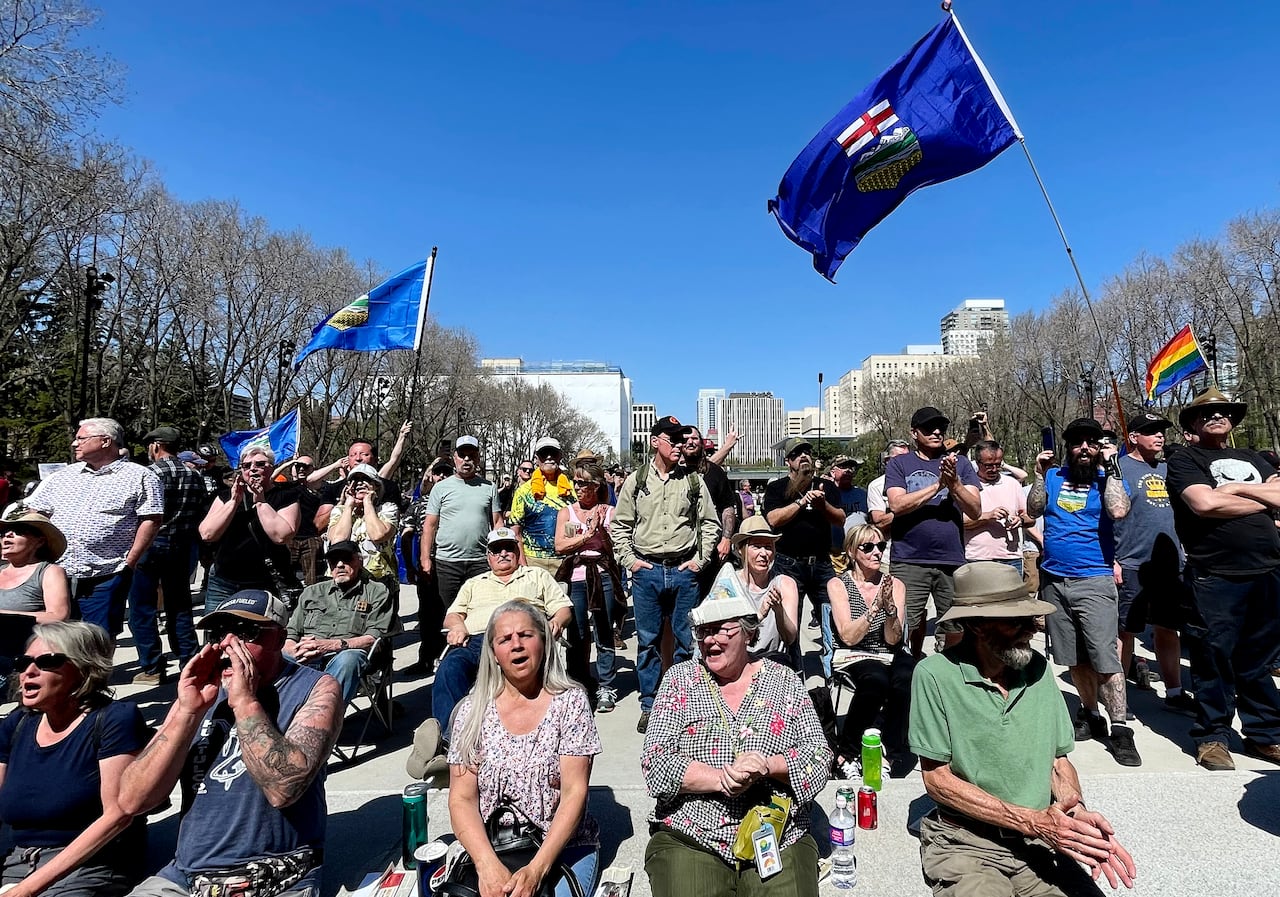
People gather at a separatist rally in Edmonton in May. (Jason Franson/Canadian Press)
Former British Prime Minister David Cameron had a similar perspective regarding the Brexit vote, and his bet proved disastrous for both his career and the United Kingdom’s membership in the European Union. Likewise, the 1980 Quebec sovereignty-association referendum may have failed significantly, with 60 percent voting against and 40 percent in favor — but it certainly did not eliminate that separatist movement.
However, Alberta’s exit referendum may differ from those precedents in one key aspect. Cameron campaigned against Brexit, while the then-premier René Lévesque of the Parti Québécois led the 1980 “Oui” campaign.
Smith has mostly refrained from declaring whether she would actively campaign for one side or the other regarding that pivotal referendum question in Alberta.
While she has consistently asserted her support for a robust Alberta within a united Canada and her desire to ensure Canada functions effectively, she has shown hesitance to overtly oppose a significant segment of her party’s membership.
Sylvestre, for his part, anticipates that she will remain neutral throughout APP’s petition drive and the potential referendum. He is comfortable with that stance.
“Let the citizens decide, so to speak,” he remarked.
“We do not require government intervention in every matter.”
Nevertheless, since the UCP has intervened twice with legislation to lessen the requirements for APP to advance its independence question to the ballot, some within the movement might feel that Smith’s administration has already taken sufficient action.