
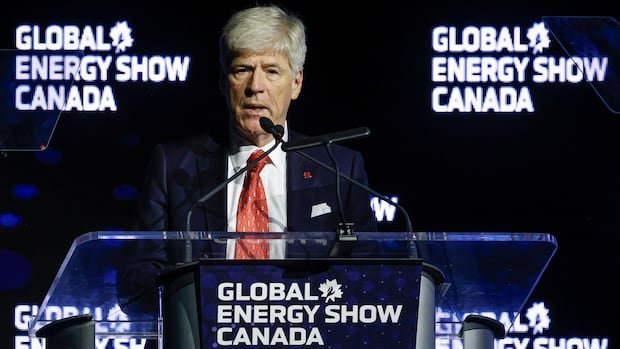

Federal Minister of Natural Resources, Tim Hodgson, emphasized Canada’s potential as a reliable energy supplier amidst global uncertainty at the Global Energy Show in Calgary. However, the CEO of a prominent oilsands company questioned Canada’s commitment, citing concerns over linking support for a new West Coast pipeline to emissions reduction initiatives and a carbon levy.
Hodgson, addressing the conference, highlighted Canada’s reliability, democracy, and renewed openness for business amid global energy market turmoil. The event, with an expected attendance of 30,000, aimed to attract more international participants this year.
Emphasizing the interconnectedness of energy policy with economic, security, trade, and investment policies, Hodgson stressed that while Canada is not waiting for the world, it is actively stepping up to the challenges.
Last year, Alberta Premier Danielle Smith advocated for a new bitumen pipeline to the northwest coast, with plans for the province to submit an application for the project by July 1. The pipeline’s realization hinges on the Pathways carbon storage project and the collaboration between Alberta and Ottawa.
Cenovus Energy Inc. CEO Jon McKenzie acknowledged the improved collaboration between federal and provincial governments but expressed reservations about the impact of new carbon pricing mechanisms on oilsands producers’ confidence and investment.
Under the Pathways project, Canada aims to reduce carbon dioxide emissions by 16 megatonnes by 2045, with oilsands companies leading efforts to capture and store CO2. However, McKenzie raised concerns about the financial burden of the project and its minimal impact on global emissions.
McKenzie criticized the industrial carbon tax, labeling it as detrimental to the competitiveness of Canadian energy investments, particularly in the oilsands sector. He highlighted the financial challenges of the Pathways project, estimating costs between $20 billion to $30 billion while questioning its benefits for Canada.
Regarding the new West Coast pipeline, McKenzie noted the lack of private sector financing under current conditions, emphasizing the need for a more competitive investment environment to drive industry participation and growth.
The Alberta government targets the pipeline’s designation as a project of national interest by October, aiming to commence construction by September 2027. Premier Smith underscored the importance of translating commitments into actions to attract business investments and drive economic growth.