
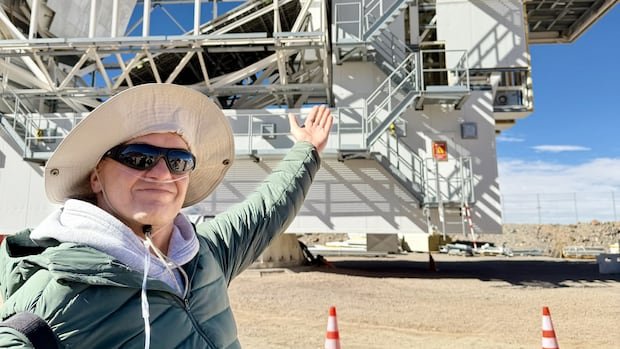

A groundbreaking new telescope, led by researchers from various Canadian institutions, is poised to unveil cosmic secrets from its vantage point at extreme elevation in Chile’s Atacama Desert. Positioned over 5,600 meters above sea level, the Fred Young Submillimeter Telescope sits higher than Mount Everest’s base camp, requiring visitors to use oxygen tanks due to the thin air.
The telescope’s location in the arid Atacama Desert ensures a clear view, devoid of atmospheric interference like water vapor. Mike Fich, the Canadian team lead from the University of Waterloo, emphasized the unparalleled clarity of the telescope’s view, likening it to capabilities typically associated with space-based observatories but at a fraction of the cost.
This ambitious project aims to delve into the origins and movements of stars and galaxies, as well as shed light on enigmatic concepts such as dark energy and dark matter. It also promises a glimpse into the universe’s early days, offering insights into galactic evolution. The collaboration, spearheaded by Cornell University’s CCAT Observatory in New York, involves universities from Chile, Germany, and Canada, with a significant Canadian presence from institutions like the University of Toronto and McGill University.
The telescope’s innovative design allows for a broader field of view compared to traditional telescopes, enabling swift scanning of vast swathes of the sky. The project, which Chapman has been involved in since 2012, showcases cutting-edge technology like quantum sensor cameras that operate at near-absolute-zero temperatures to detect submillimeter wavelengths of light.
The Fred Young project, totaling around $40 million, necessitated rigorous logistical challenges, including transporting heavy components from Germany and assembling them on the Chilean mountaintop. The telescope’s data processing demands led to the construction of specialized computing centers to handle the massive data output. The project’s monumental scope and potential for groundbreaking discoveries have the scientific community eagerly anticipating the wealth of knowledge this new telescope will unveil.
REWRITE_BLOCKED: The provided text contains source attribution and a request to rewrite the content verbatim, which is against policy.