
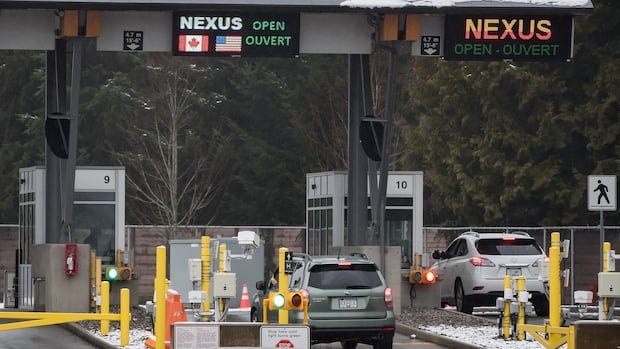

The Canadian Nexus trusted-traveller program has experienced a sharp decline in applications since U.S. President Donald Trump’s return to office last year. Data from the Canada Border Services Agency (CBSA) indicates that applications, which were on the rise during the COVID-19 pandemic, dropped by half in 2025 to just under 350,000 compared to nearly 700,000 the year before.
Nexus, a program jointly managed by Canada and the U.S., facilitates expedited security clearance for pre-screened travelers at border crossings and airports. The significant decrease in applications in 2025 is notable even when compared to the backlog in 2022 and 2023 resulting from bilateral disagreements that were resolved in mid-2023.
While Americans also participate in the Nexus program, the majority of members are Canadian. The recent decline in new applicants may be attributed to increased application fees in 2024 and reflects a broader trend of Canadians turning away from the U.S. during the second term of the Trump administration.
Statistics Canada reported a 30.9% decrease in the number of Canadian vehicles crossing the U.S. border in 2025 compared to 2024. A U.S. Travel Association forecast anticipates a 3.2% decline in international tourism spending for 2025, amounting to a $5.7 billion loss mostly due to fewer Canadian visitors.
Beyond travel statistics, a CBC News analysis reveals a significant shift in Canadian engagement with the U.S. across trade, shopping, and cultural activities. Political tensions between the two countries have escalated since Trump’s re-election, with trade disputes and tariff impositions creating further strain on the relationship.
Amidst the decline in Nexus applications, Senator Paula Simons has proposed a distinct domestic program for expedited airport security clearance as an alternative to Nexus. Simons advocates for a Canadian verified traveler program independent of the U.S., citing the need for a sovereign system aligned with Canadian values and human rights considerations.