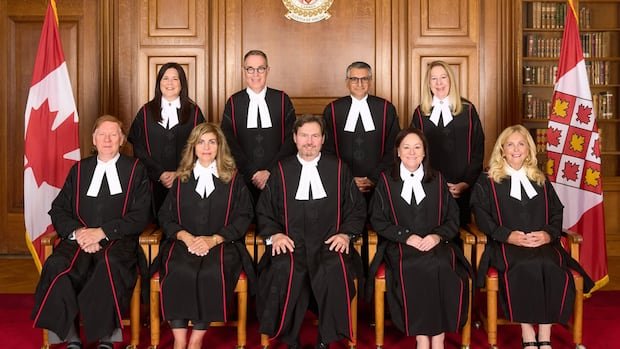


Romaine LeGallou was informed that the Supreme Court of Canada was celebrating its 150th anniversary and needed a wardrobe upgrade. From that moment, events unfolded swiftly for her.
Upon expressing interest, she received a call to present her ideas, and ultimately, her company was selected for the task. The ensuing process was no walk in the park.
“It was quite a demanding time for the team. It all happened just four weeks before I gave birth for the first time!” LeGallou chuckled.
As the CEO of Les Rabat-Joies, a boutique in Saguenay, Quebec, specializing in tailored court attire for legal professionals, LeGallou knew that adhering to specific protocols was essential when designing outfits for Canada’s highest court.
Despite the strict guidelines, the company was determined to add a touch of uniqueness. LeGallou and her team devoted countless hours to seize this extraordinary opportunity, fostering closer bonds among the small yet dedicated group.
When it comes to legal attire in Canada, precise rules dictate the dress code for lawyers and judges depending on the court. Robes are consistently black, and tabs are uniformly white.
Les Rabat-Joies offers a personalized touch to legal attire while upholding tradition. Clients have a wide array of options for tabs, ranging from intricate lace or crocheted designs to vibrant rainbow stitching and pearl accents. Moreover, standard robes can be lined with various prints, including St. Bernards, playing cards, Vespa scooters, feathers, or zebra stripes.
In essence, a custom-made robe is all business on the outside but a party on the inside. The name “Les Rabat-Joies” plays on the French term “rabat-joie,” signifying a killjoy, while also referencing the tabs or bands worn by lawyers and judges in court.
Stéphanie Gobeil, the assistant director at Les Rabat-Joies, aims to inject a sense of fun and unexpected flair into the courthouse attire, offering clients a distinctive and vibrant legal wardrobe.
The team at Rabat-Joies dedicated their spring and summer to crafting individualized attire for each of the nine Supreme Court justices. Myriam Herrera, the technical lead at Les Rabat-Joies, who started her career as a dressmaker in Nicaragua at the age of 14, played a pivotal role in this process.
The team’s goal is consistent across all custom orders, ensuring that every client receives the desired product through collaborative design and adjustments. Traveling to Ottawa, LeGallou and Herrera meticulously tailored the new robes for the justices, sourcing premium black silk from Korea and intricately embroidering the Cormier emblem, the symbol of the Supreme Court of Canada, onto the fabric.
Each robe demanded 40 hours of meticulous work, epitomizing the team’s commitment to perfection. The ceremonial robes were unveiled at the commencement of the Supreme Court season in Ottawa and were well-received, with Chief Justice Richard Wagner commending the modern yet Canadian design that upheld the dignity and authority of the judicial role.
The move by the Supreme Court to modernize its attire is seen as an endorsement for courts nationwide to embrace change. The team’s effort on the Supreme Court wardrobe has garnered attention, resulting in increased business for Les Rabat-Joies.
Looking ahead, the challenge lies in retaining the team amid changes to immigration policies that could affect the two staff members on temporary work permits. LeGallou is advocating for a solution that would allow her employees to continue working in Canada, emphasizing her commitment to their well-being and the success of her business.
The legal battle to secure the team’s future is crucial, especially considering the growing demand for their unique creations across Canada. LeGallou remains resolute in her vision to operate from Saguenay while catering to clients nationwide.