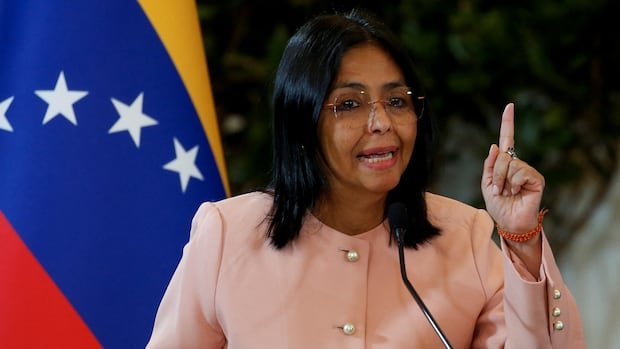


Delcy Rodríguez has assumed leadership in Venezuela temporarily as Nicolás Maduro, her ally, was apprehended by the United States in a military operation and transferred to New York City to face criminal charges. Following a court order on Saturday, Rodríguez was appointed interim president, supported by Venezuela’s military, and was officially sworn in on Monday.
Expressing regret for the suffering inflicted on the Venezuelan people due to what she termed an illegitimate military intervention, Rodríguez raised her right hand and declared, “I come with sorrow for the kidnapping of two heroes.” Serving as Maduro’s vice-president since 2018, she has had oversight of Venezuela’s oil-dependent economy and intelligence services, and was next in line for the presidency. Additionally, from 2014 to 2017, she held the position of foreign minister.
While President Donald Trump has been critical of the Maduro regime since his first term, Rodríguez is among the senior officials now assumed to be in control of Venezuela, with Trump excluding immediate involvement from the country’s conservative political opposition. Facing U.S. sanctions during the first Trump administration for aiding Maduro in maintaining power, Rodríguez was also sanctioned by the Canadian government in 2018 on similar grounds.
With a background as a lawyer and politician, Rodríguez has been a staunch supporter of the socialist revolution initiated by Hugo Chávez, Maduro’s predecessor. Over the years, she has held various key positions in the government, including foreign affairs minister and petroleum minister, playing a crucial role in stabilizing Venezuela’s economy amidst ongoing crises.
Rodríguez has established strong ties with the U.S. oil industry and Wall Street Republicans who oppose U.S.-led regime changes. Moreover, she has maintained a close relationship with the military, traditionally a significant player in Venezuela’s political landscape. Her family has a history of political involvement, with her father being a socialist leader who tragically died in police custody in 1976.
Rodríguez’s sudden ascension to interim leadership was unexpected, following communication between U.S. Secretary of State Marco Rubio and herself, indicating a potential willingness to work with the U.S. administration. While initially adopting a firm stance against the U.S., Rodríguez later expressed a more conciliatory tone, inviting collaboration with the U.S. government for mutual development within the framework of international law.
As uncertainty looms in Venezuela, with Maduro’s capture sparking mixed reactions, the constitution mandates an election within 30 days in the event of the president’s permanent unavailability. However, Maduro’s absence has been deemed temporary by the loyalist Supreme Court, allowing for a different course of action that could extend Rodríguez’s tenure beyond the prescribed period.
Despite calls for a peaceful transition, Venezuela remains tense, with Maduro’s supporters in power and the military showing no signs of dissent. Citizens are reportedly stocking up on essentials amid the prevailing unease, awaiting clarity on the country’s future leadership and direction.