
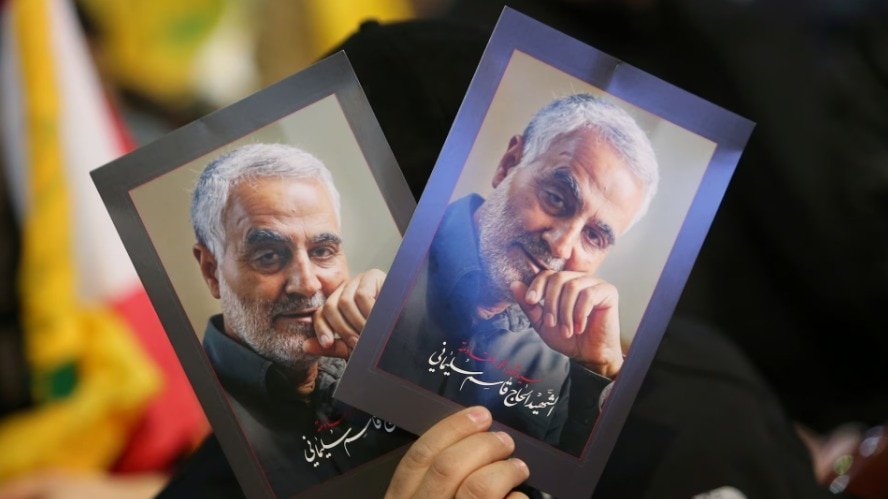

US federal authorities have apprehended the niece and grand-niece of the deceased Iranian military commander Qassem Soleimani after their Green Cards were revoked, as confirmed by the State Department on Saturday. Green Cards grant foreign nationals the privilege to reside and work permanently in the US, with a potential pathway to citizenship after a few years.
Hamideh Soleimani Afshar and her daughter are currently under the custody of US Immigration and Customs Enforcement following the annulment of their Green Cards by Secretary of State Marco Rubio, according to the State Department’s statement. These arrests occurred amidst the ongoing US-Israel conflict with Iran, now in its sixth week without any signs of resolution.
Qassem Soleimani, the former leader of the Quds Force, a branch of Iran’s Revolutionary Guards responsible for external operations, was killed in a US drone strike on January 3, 2020, near Baghdad International Airport during Donald Trump’s presidency. The US accused him of orchestrating attacks carried out by Iran-affiliated militias against American troops.
The State Department declared that Hamideh Soleimani Afshar was identified as an avid supporter of Iran’s “totalitarian, terrorist regime,” promoting Iranian regime propaganda, glorifying assaults on American soldiers, adoring Iran’s Supreme Leader, condemning the US as the “Great Satan,” and unwaveringly backing the Islamic Revolutionary Guard Corps (IRGC), designated as a terrorist organization by Washington.
Authorities have revoked the legal permanent resident status of both Afshar and her daughter, while barring her husband from entering the US. Additionally, the State Department recently rescinded the legal status of Fatemeh Ardeshir-Larijani, the daughter of former Iranian official Ali Larijani, and her spouse Seyed Kalantar Motamedi. Both individuals are no longer in the US and are prohibited from future entry.
In a national address, President Trump reflected on his decision to eliminate Soleimani during his term, emphasizing that the situation in Iran may have differed had Soleimani survived. Trump underscored his actions to curtail Iran’s nuclear ambitions and highlighted Soleimani’s role as a malevolent strategist and the mastermind behind improvised explosive devices.
Soleimani was a key architect of Iran’s regional strategies and proxy networks, recognized as one of the most influential military figures in the Middle East. Despite being revered in Iran, he was perceived by the US as a formidable adversary and a significant power broker within the region, exerting influence in critical negotiations concerning Iraq’s governance.
– Ends