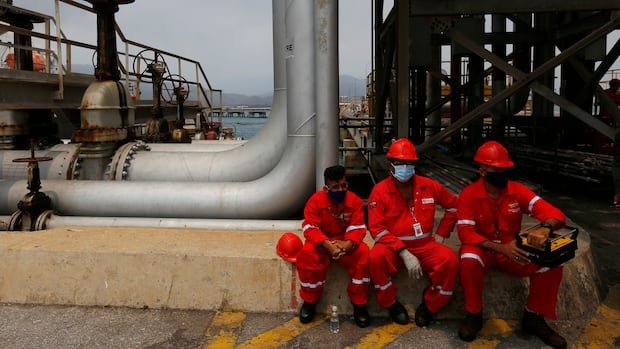


U.S. President Donald Trump’s scheme to assume authority over Venezuela’s oil sector and invite American corporations to revamp it post the capture of leader Nicolas Maduro in a covert operation is poised to encounter numerous obstacles — logistically, legally, and politically. The sudden capture of Maduro marked the culmination of an extensive pressure campaign by the Trump administration against Venezuela’s authoritarian leader and involved months of clandestine preparations, culminating in the most decisive American intervention to effect regime change since the 2003 Iraq invasion. While Washington has levied narco-terrorism charges against Maduro, the Venezuelan government has long alleged that Trump and the U.S. were eyeing the nation’s abundant natural resources.
Venezuela boasts the largest proven crude oil reserves globally, estimated at around 303 billion barrels as per the U.S. Energy Information Administration, surpassing both Canada and Saudi Arabia and representing approximately 17% of the world’s oil reserves. Despite these vast reserves, Venezuela’s crude oil production has dwindled to less than 1% of the global supply, dropping from a peak of 3.5 million barrels per day in 1999 to the current output of about a million barrels per day, according to OPEC data.
The decline in Venezuela’s oil production can be attributed to a combination of factors, presenting several challenges for Trump to achieve his goal of exporting Venezuelan oil. Heather Exner-Pirot, the director of energy, natural resources, and environment at the Macdonald-Laurier Institute, highlighted that nationalization, mismanagement, and corruption have led to the deterioration of Venezuela’s oil industry. Additionally, the nation’s economy, including its oil sector, has been severely impacted by stringent U.S. sanctions imposed starting in 2015, when Caracas was labeled a national security threat.
Furthermore, subsequent sanctions enforced by Trump in 2017 and 2019 significantly curtailed Venezuelan oil exports to the U.S., with a recent complete blockade on the industry described by Secretary of State Marco Rubio as a “quarantine on their oil.” Roxanna Vigil, an international affairs fellow at the Council on Foreign Relations, emphasized that reviving the oil sector in Venezuela would require substantial investments amounting to tens of billions of dollars and a prolonged period, potentially spanning several years to a decade.
The challenges extend beyond infrastructure issues to encompass political and legal complexities. Francisco Monaldi, the director of the Latin American energy program at Rice University, emphasized the necessity for foreign companies to have clarity on Venezuela’s political stability and contractual framework before investing in the country. Vigil underscored the need for Venezuela to undergo constitutional reforms to foster a more business-friendly environment and transition its economy away from socialism, a shift initiated by Chavez’s nationalization policies that expelled major international players from the oil sector.
In addressing the legal aspects, experts raised concerns regarding the lawfulness of the U.S. operation that led to Maduro’s capture, conducted without congressional approval. Questions also loom over the legality of Trump’s ambitions to leverage Venezuelan oil resources. While the U.S. has not physically occupied Venezuela, its increasing military presence in the region coupled with Trump’s statements asserting American control over the country’s oil industry pose legal ambiguities, particularly concerning the principle of permanent sovereignty over natural resources enshrined in UN Resolution 1803.
The debate extends to the ownership of Venezuela’s oil reserves, with the Trump administration likely asserting that the Venezuelan government lacked rightful ownership, citing historical U.S. contributions to the development of the Venezuelan oil industry. Stephen Miller, the White House deputy chief of staff, previously underscored the role of American investments in Venezuela’s oil sector and criticized past Venezuelan regimes for exploiting the industry.
Ultimately, Trump’s plan to overhaul Venezuela’s oil industry confronts multifaceted challenges encompassing logistical constraints, legal uncertainties, and political dynamics, underscoring the intricate landscape surrounding the nation’s valuable oil resources.