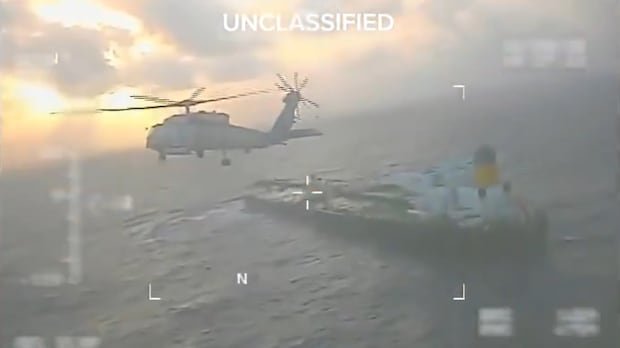


Secretary of State Marco Rubio was asked over the weekend about the potential U.S. government intervention in governing Venezuela post the apprehension of President Nicolás Maduro. In response, Rubio redirected attention to the enforcement of a U.S. blockade on sanctioned oil tankers, emphasizing its significance in driving policy changes in Venezuela. Referring to this blockade as a crucial tool in managing Venezuela, President Donald Trump highlighted its role during an interview on CBS News’ Face the Nation.
Exploring the origins, implications, legality, and effectiveness of the blockade, here is an overview.
Background of the Blockade
On December 16, Trump declared on his social media platform, Truth Social, that Venezuela was encircled by a significant armada in South America’s history. Consequently, he ordered a comprehensive blockade on all sanctioned oil tankers entering or leaving Venezuela. This action was a response to Venezuela being labeled a “foreign terrorist organization” for various offenses, including the misappropriation of U.S. assets.
The sanctioned vessels, identified by the U.S. Treasury Department, numbered more than 30 at the time of Trump’s declaration, as reported by the New York Times referencing data from Tanker Trackers. These vessels, part of an illicit “shadow fleet,” clandestinely transport crude oil into global markets by manipulating their identification systems to conceal their activities.
According to the Treasury Department, Maduro’s regime heavily relies on this shadow fleet to engage in activities that violate sanctions and generate revenue to support destabilizing operations.
Debate on Terminology
While Trump termed it a “blockade,” officials like Rubio have labeled it a “quarantine,” focusing on combating illicit operations rather than initiating an act of war. International law defines a blockade as a wartime strategy, prompting experts like Andrew Latham to suggest that the term “quarantine” better aligns with the legal framework governing such operations.
Mark Nevitt, a law professor at Emory University, highlighted the legal basis for intercepting stateless or dual-state claimed vessels, emphasizing the discrepancy between the blockade’s portrayal and its selective implementation.
Interceptions and Evasions
Although only two vessels have been intercepted thus far, the enforcement of the blockade has faced challenges. Notably, several oil tankers under sanctions have managed to evade interception by concealing their locations or turning off tracking signals, as reported by the New York Times.
The impact of the blockade on Venezuela’s economy is already apparent, with oil exports, crucial for revenue generation, grinding to a halt. The state-owned company PDVSA has faced production cuts due to the storage overflow, potentially leading to a substantial decline in oil production if the blockade persists.
Tag: rewrite-pending