
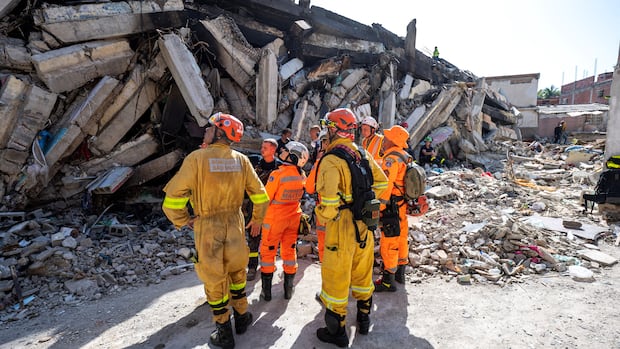

As the opportunity to locate survivors diminishes rapidly, Venezuelans scoured through more debris on Monday from buildings that collapsed due to the catastrophic twin earthquakes that struck last week, with an aftershock shaking the disaster area in the northern state of La Guaira.
Relief agencies indicate that the initial 72 hours following a natural calamity are critical for rescue operations, although survival chances can improve if individuals have access to food and water. Five days after the dual earthquakes impacted northern Venezuela, focus has shifted to the emerging humanitarian crisis in the affected areas.
The official death count has surpassed 1,700, as reported by the government.
Significant concerns arise regarding the ability of the financially strained government led by acting President Delcy Rodríguez — who assumed leadership in January after the Trump administration took control from former president Nicolás Maduro — to orchestrate the necessary efforts to assist the thousands left homeless.
In light of criticism that officials have been slow to respond, the government has highlighted its rescue operations through social media and state-run outlets. On Monday, it released videos showing Rodríguez visiting a school converted into a shelter for those displaced in the severely affected northern town of Catia La Mar, as survivors were being rescued from the rubble to the sound of applause.
Yet, such moments of positivity are scarce at the quake’s epicenter, where families maintain a vigil at the search sites.
“We must remain strong, even without food or rest,” stated Ana Rada, watching as civil defense personnel searched for her brother.
“As long as I have not seen the body, I hold onto hope.”
Aftershock disrupts rescue operations
After a weekend of minor aftershocks, Monday’s tremor hit close to the epicenter of last week’s earthquakes — 27 kilometers north of Caraballeda on Venezuela’s Caribbean shore — registering a magnitude of 4.6, according to the United States Geological Survey. Colombia’s geological survey reported it as 5.1.
Jorge Rodríguez, head of the Venezuelan National Assembly, remarked that there were no immediate reports of further destruction; however, the aftershock caused residents in the capital, Caracas, to flee into the streets in panic.
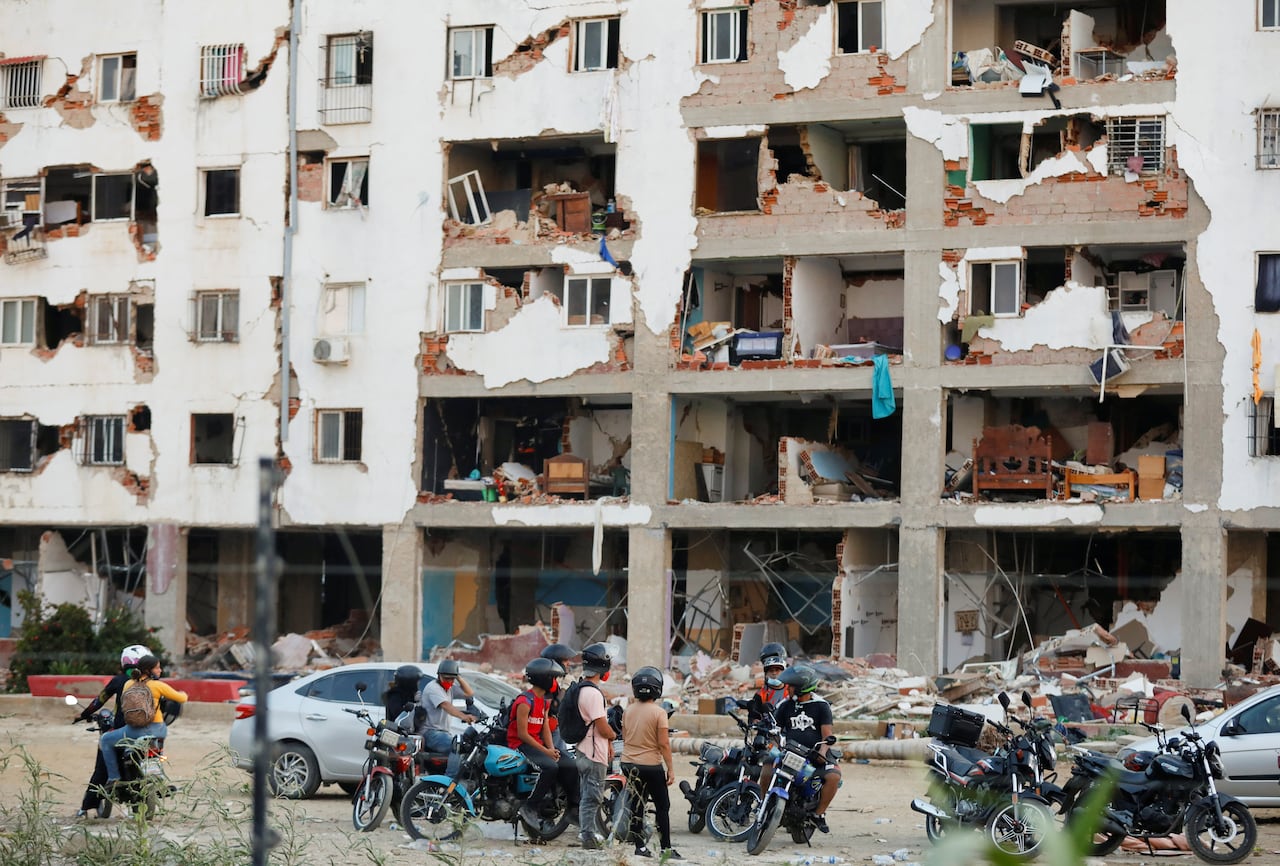
Individuals observe a building wrecked by earthquakes in La Guaira on Sunday. (Fausto Torrealba/Reuters)
“Here we are again, back in the streets. I don’t know when we will finally have a moment of true tranquility,” lamented Concepción Hernández, 51, who evacuated her apartment in the Chacao municipality of Caracas.
The Caracas Metro announced a temporary suspension of services on Monday to assess infrastructure following the aftershock.
Additional damage is anticipated as a tropical wave approaches Venezuela, which is predicted to bring heavy rainfall, according to Gianluca Rampolla del Tindaro, the UN resident coordinator in Venezuela.
“You can imagine the implications for the displaced individuals,” he remarked, noting that over 12,000 people are affected so far, although all statistics are likely to fluctuate in the coming days.
‘Operating without gloves or equipment’
The disaster has raised expectations for the Trump administration, particularly following its takeover of Venezuela’s oil sector earlier this year.
In a press briefing, a senior State Department official stated that 300 first responders from the U.S. are currently on the ground, collaborating with numerous international rescue teams, while two dozen C-17 military transport aircraft deliver supplies daily. U.S. financial aid has now surpassed $300 million.
The American military is also providing assistance with repairs, including addressing damage to the port in La Guaira to facilitate the arrival of more relief supplies by sea. Another unit is managing air traffic after part of the control tower at Simón Bolívar International Airport in Caracas was damaged during the quakes, according to the official, who spoke on condition of anonymity due to lack of authorization to speak publicly.
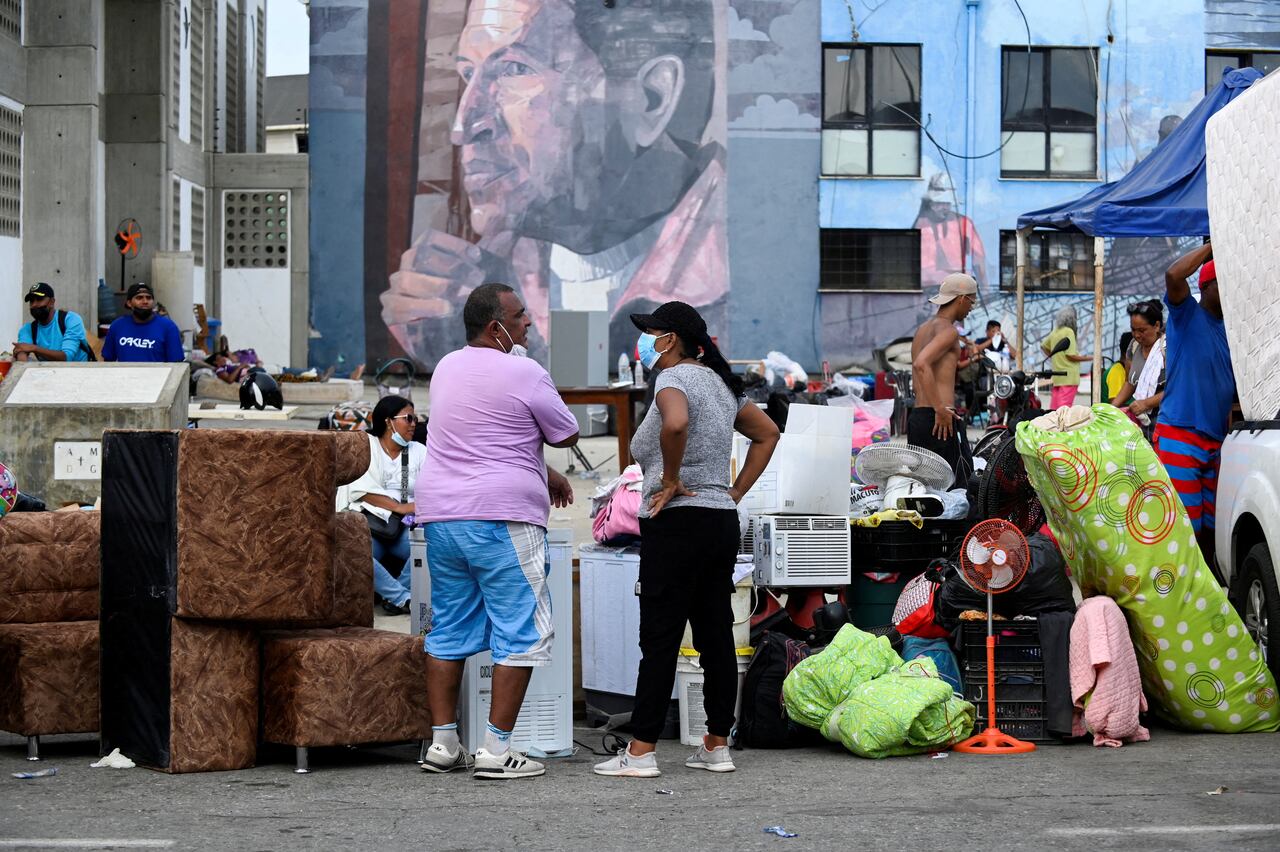
Individuals gather with their belongings near a mural of late Venezuelan President Hugo Chavez after the earthquakes struck the nation in La Guaira, on Sunday. (Maxwell Briceno/Reuters)
However, it seems improbable that the Trump administration would provide temporary legal protections to Venezuelans, as previous governments have done for individuals from disaster-affected nations already residing in the U.S. Such measures were implemented after the 2010 Haiti earthquakes and the 2001 earthquakes in El Salvador.
Among those assisting in rescue efforts on Monday in La Guaira was miner Jean Sosa, 31, who was deported from the United States in January due to a missed immigration court appearance and arrived in Caracas last month. His journey involved a bus ride through five countries after immigration agents abandoned him in southern Mexico without his passport, phone, or wallet.
Since arriving in La Guaira on Wednesday to visit family and friends, Sosa has been working tirelessly to rescue individuals from the debris due to the lack of national rescue teams.
“I’m not engaged in politics, but I think many lives could have been saved if there had been proper equipment and support from higher authorities from the very start,” he told The Associated Press, wearing a helmet and a black T-shirt stained with dust in the port city where he claims to have already rescued 20 living individuals.
These rescues have inspired him, providing hope for more despite the severe shortage of resources.
“We’re working without gloves, without proper equipment, borrowing supplies, improvising bandages and anything else we can find,” he stated. “But we’re still here, still fighting.”
Discrepancies in data
The complete extent of the destruction remains uncertain. Jorge Rodríguez, sibling of the acting president, stated that by Monday, a total of 15,866 individuals had been impacted, with the number of damaged or collapsed structures reaching 855.
An initial assessment by NASA estimated that the earthquake impaired or obliterated 58,870 buildings. The United Nations has indicated that as many as 6.8 million of Venezuela’s nearly 30 million inhabitants may be affected, potentially facing displacement or losing access to vital services like electricity and water.
Due to the disarray and unreliable cellphone service, many Venezuelans have resorted to non-governmental digital databases to report their missing relatives. Over 50,000 individuals were listed as missing on one such database, although it is unclear how many have been located.
Included among the missing are over 100 Venezuelans recently deported from the U.S. who were staying in a hotel when the quakes occurred.
-
Some Venezuelans fear a dark and dangerous future in aftermath of twin earthquakes
-
Londoners send truckload of food, supplies to Venezuela after deadly earthquakes
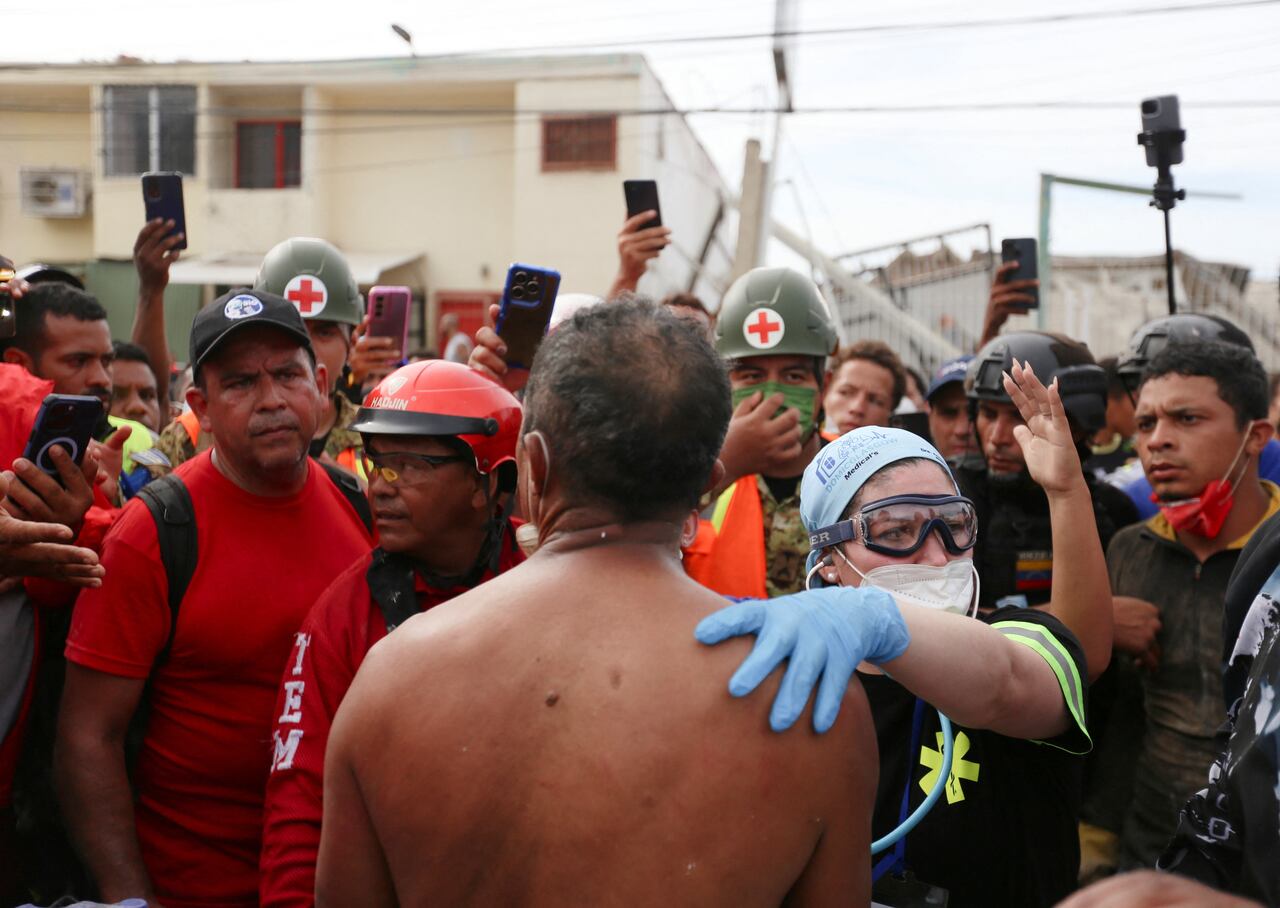
A nurse checks on a volunteer who was trapped for several hours until rescued from beneath the debris of a building in La Guaira on June 28. (Fausto Torrealba/Reuters)