
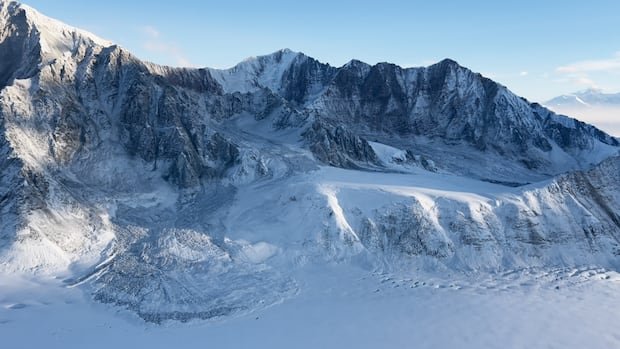

A team of researchers from the Yukon Geological Survey is currently conducting aerial surveys in a remote mountainous area in southwest Yukon to assess the impact of a magnitude 7.0 earthquake that occurred recently. The earthquake struck near the Alaska-Yukon border on December 6, providing evidence of a concealed fault beneath the Earth’s surface, as confirmed by geologists.
The convergence of two significant plate boundary systems in the southwestern corner of the Yukon has intrigued experts like Michael West, Alaska’s state seismologist. This unique geological intersection has been described as the ‘train wreck of plate tectonics.’ The earthquake highlighted an area with historically low seismic activity, prompting researchers to investigate the connection between the North American plate boundary and interior faults.
The earthquake, which was felt most strongly in Burwash Landing and Haines Junction, Yukon, also caused ground shaking in Whitehorse, approximately 250 kilometers away. Residents, like Pascale Dubois, experienced intense shaking during the event, with fears of their homes collapsing. Despite the strong earthquake, the impact on the region was relatively minor, according to Michael West.
Researchers have been actively studying the aftermath of the earthquake in Yukon’s Kluane National Park, where field reconnaissance efforts have revealed landslides and other evidence of geological shifts. The ongoing aftershocks are expected to provide valuable insights into the mountain-building processes in the area and contribute to a better understanding of earthquake risks for nearby communities.
The research and mapping of fault lines resulting from the earthquake are crucial for enhancing earthquake preparedness and risk assessment in the region, with international interest in the findings expected to yield new insights into seismic activity and fault systems.