
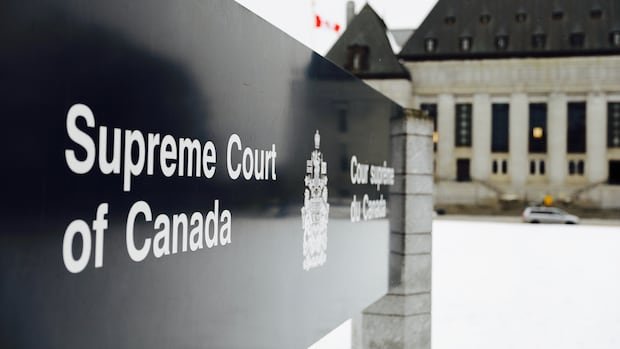

Lawyers representing the attorneys general of Canada and several provinces presented arguments to the Supreme Court of Canada on Tuesday, advocating for the support of a Quebec law that permits police to conduct routine traffic stops without specific cause. Conversely, civil rights organizations argue that such stops often result in racial profiling.
The Supreme Court dedicated a second morning to deliberating whether it is constitutional for law enforcement to conduct traffic stops without reasonable suspicion of an offense being committed by the driver.
At the center of the debate is Joseph-Christopher Luamba, a Black Montreal resident in his twenties, who reported being frequently stopped by police without apparent justification while driving or being a passenger in vehicles. None of these stops led to any tickets being issued.
Following Luamba’s challenge, Quebec’s Superior Court declared the provision in Quebec’s Highway Safety Code allowing random traffic stops inoperative in 2022 due to concerns of racial profiling. This decision was upheld by the Court of Appeal in 2024. Consequently, the Quebec government is appealing this ruling, a case with potential ramifications nationwide.
During the proceedings, Federal Justice Department lawyer Marc Ribeiro asserted that police require discretionary power to conduct random traffic stops to combat impaired driving effectively. He illustrated a scenario where a police officer observes a group leaving a late-night house party and decides to pull them over, highlighting situations where reasonable suspicion of an offense is not present.
The 2022 ruling overturned regulations established by a 1990 Supreme Court decision, R. v. Ladouceur, which justified police summons for an Ontario driver stopped randomly while driving with a suspended license. The Supreme Court at that time deemed random stops necessary to verify driver licensing, seatbelt compliance, and detect impaired driving.
The debate also involved interveners such as civil rights groups, advocates for Black and Indigenous communities, police chiefs, and Mothers Against Drunk Driving. The discussion centered on whether racial profiling is an inevitable result of laws allowing discretionary stops, a crucial factor in determining constitutionality.
While acknowledging the existence of profiling, Ribeiro and the attorneys general of Ontario, British Columbia, Saskatchewan, and Alberta proposed alternative measures to combat it without revoking police authority to make stops without specific cause. Suggestions included data tracking by police forces, facilitating victim recourse, and government declarations to prevent discriminatory enforcement.
Both Mothers Against Drunk Driving and the Canadian Association of Police Chiefs contended that spot checks are essential for deterring and identifying impaired, unlicensed, uninsured drivers, and unsafe vehicles. Conversely, advocates from organizations like the African Nova Scotia Justice Institute and the Black Legal Action Centre argued that the disproportionate stops of racialized individuals demonstrate inherent profiling resulting from the law.
The judges are now deliberating the case, with no timeline given for a decision.