
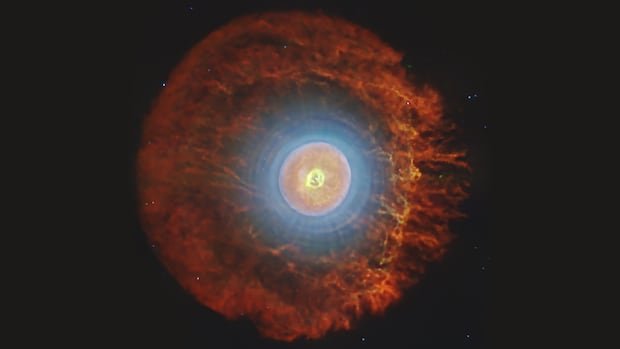

A distinctive molecule resembling a soccer ball shape is providing valuable insights into the life and death processes of stars in deep space. After 15 years since the initial discovery of “buckyballs” outside of Earth, astronomers from Western University have revisited the phenomenon with a fresh perspective on the origins of these peculiar molecules. Utilizing the advanced James Webb Space Telescope, the team conducted a study on a remote gas and dust cloud known as planetary nebula Tc 1, situated over 10,000 light-years away.
Planetary nebulae come into existence as stars, similar to our sun, approach the end of their lifecycle and release their outer layers into the cosmos. Within Tc 1, scientists had previously identified buckminsterfullerene, a molecule comprised of 60 carbon atoms structured in a hollow sphere resembling a soccer ball. This breakthrough, initially detected in 2010 through NASA’s Spitzer Space Telescope, confirmed the natural formation of these intricate carbon molecules in space.
Fresh imagery and data obtained from the James Webb telescope are now showcasing Tc 1 in unprecedented clarity. The imagery displays luminous gas in varying hues, with warmer sections appearing blue and cooler material in shades of red. Additionally, it captures intricate filaments and shells, alongside an enigmatic structure near the core bearing a resemblance to an upside-down question mark.
Jan Cami, the lead researcher of the recent observation program, expressed, “Tc 1 was already remarkable as it unveiled the presence of buckyballs in space, but this latest image reveals that we had merely scratched the surface. The formations we are now observing are awe-inspiring, raising as many inquiries as they resolve.”
The visualization of the buckyball was meticulously processed by Katelyn Beecroft, a London-based amateur astronomer and high school educator. Her expertise in extracting subtle features from telescope data led to her inclusion in the research team.
Scientists highlight that the novel data contains intricate chemical “signatures” that could potentially elucidate the mechanisms behind the formation of these molecules and the reasons for their intense luminosity, longstanding enigmas that have intrigued researchers for years.