
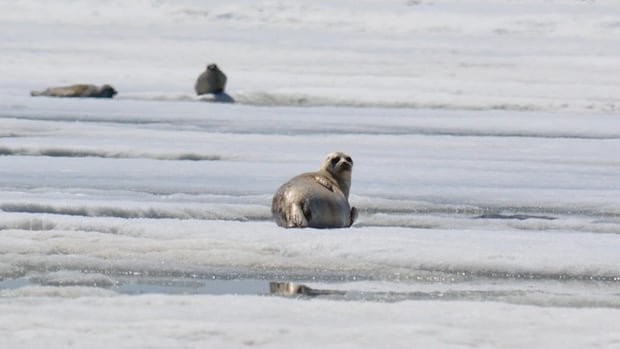

Ringed seals in Hudson Bay are observed to take risks in search of a diverse menu, even if it means facing potential predation by polar bears. A recent study published in Ecology Letters delves into the intricate predator-prey dynamics between these seals and polar bears, highlighting the importance of considering this relationship when designating marine protected areas.
The study reveals that while ringed seals typically avoid areas frequented by polar bears, they may venture into high-risk zones for abundant or varied food sources. Lead author Katie Florko, a research scientist at the University of British Columbia, expresses interest in how seals navigate the balance between foraging and avoiding predation. The research found that seals would tolerate increased predation risks for the promise of substantial rewards, such as plentiful or diverse fish.
Using satellite telemetry transmitters, researchers tracked the movements and dives of 26 seals near the Belcher Islands in Nunavut, southeast Hudson Bay. Simultaneously, GPS collars monitored 39 polar bears in the area over a three-year period, yielding over 18,000 locations. This data enabled the scientists to map the bears’ territory and identify zones with heightened predation risks for seals.
The study notes that ringed seals exhibit shorter dive durations in high-risk areas, potentially allowing them to quickly retreat to alternate breathing holes or lairs upon detecting polar bear presence. Proper modeling is emphasized as crucial for establishing protected areas, encompassing both the availability of food for seals and the pressure from polar bears as predators.
Failure to account for the element of fear could result in safeguarding areas already avoided by seals, warns Marie Auger-Méthé, the study’s statistician. The Arctic’s rapidly changing climate could further impact predator-prey interactions, with phenomena like increased polar bear concentrations on shrinking pack ice and shifting fish distributions.
Brendan Kelly, chief scientist at the International Arctic Research Center at the University of Alaska Fairbanks, commends the study as a significant step toward understanding the constraints on seal distribution. However, he suggests caution in drawing broad conclusions without considering additional factors influencing seal behavior, such as other predators, diving oxygen levels, and breeding season dynamics.
Despite some reservations, Kelly acknowledges the study’s value in shedding light on seal behavior amidst evolving environmental conditions, emphasizing the need for nuanced interpretations before translating findings into practical management strategies.