
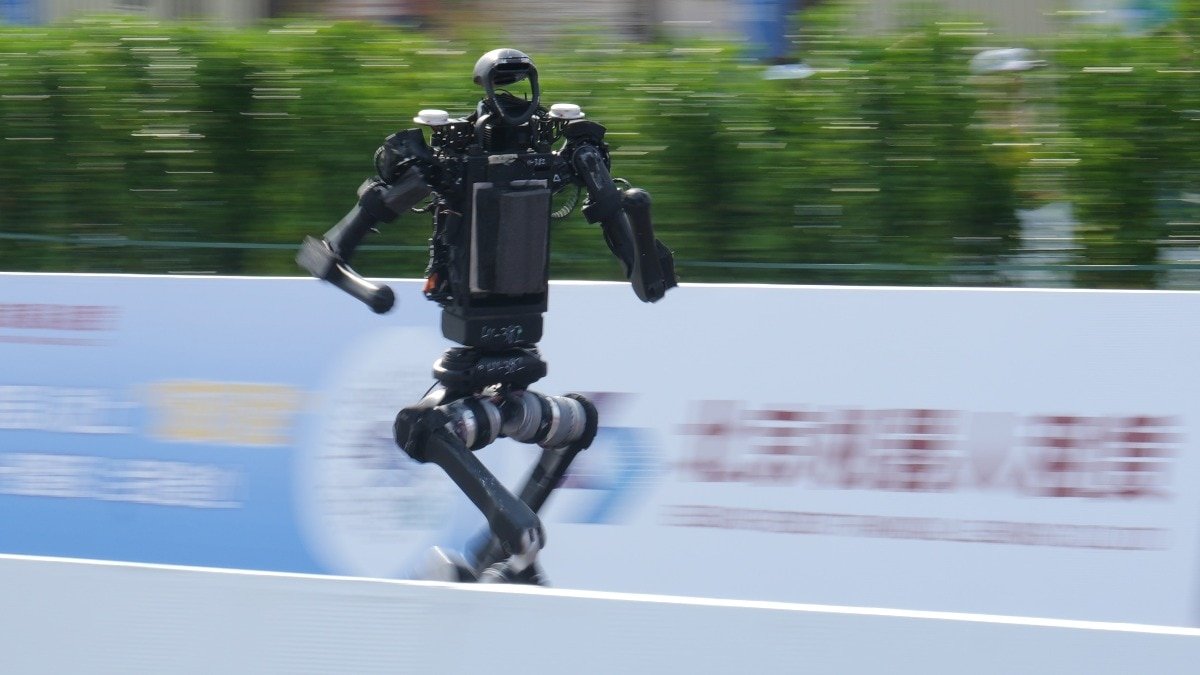

Robots powered by artificial intelligence have recently completed a half marathon in Beijing, China, showcasing their potential in track and field. Over 100 humanoid robots participated in the 21.1-kilometre race, running alongside human competitors while being separated by barriers for a fair comparison of speed, balance, and endurance.
Among the participants, a humanoid robot created by Chinese smartphone manufacturer Honor stood out, finishing the race in an impressive 50 minutes and 26 seconds. This timing surpassed that of the fastest human runner, who completed the course in 1 hour, 7 minutes, and 47 seconds. The event demonstrated significant advancements in robot technology, with many robots displaying enhanced balance, coordination, and stamina compared to previous attempts.
Approximately 40% of the robots in the race operated autonomously, utilizing onboard sensors and AI systems to navigate the course and adjust their movements in real time. While the top-performing robot showcased remarkable agility, it also faced challenges, such as briefly clipping a railing near the finish line, highlighting the ongoing need for technological refinement.
Engineers attributed the success of these humanoid robots to designs that mimic human movement patterns closely. By optimizing leg structures for efficient strides and implementing liquid cooling technology to prevent overheating, robots exhibited more stable and fluid movements during the race. Spectators noted the improved agility and motion of the robots, with many expressing interest in the rapid development of AI and robotics.
Despite the impressive performance of the robots, experts caution that running a controlled race is different from operating in unpredictable real-world environments. Humanoid robots still face hurdles in areas like fine motor skills, adaptability, and decision-making under varying conditions. While the advancements are remarkable, there is ongoing work needed to enhance the capabilities of humanoid robots for broader applications.