
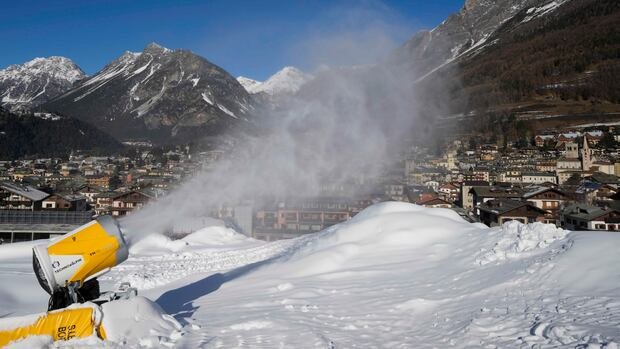

In less than a fortnight, a multitude of athletes and a vast audience will gather in the frosty locale of Cortina d’Ampezzo for the commencement of the Olympic Winter Games. However, compared to seven decades ago when the town last hosted the event, recent analysis from the U.S.-based non-profit Climate Central reveals that average temperatures have risen by over three degrees. Following the 1956 Winter Games, February temperatures averaged around -7 degrees Celsius. In the period between 2016 and 2025, this figure has climbed to -2.7 degrees Celsius.
Kristina Dahl, the Vice President for Science at Climate Central, highlighted this significant warming trend, emphasizing its impact on transitioning from freezing to thawing temperatures. Utilizing a global temperature dataset dating back to the 1940s, Climate Central discovered a reduction of 41 days per year in Cortina with temperatures below freezing compared to historical records. Maintaining naturally cold and snowy conditions is critical to providing optimal competition environments for athletes, as stated by Dahl in an interview with CBC News.
The report also notes a shift in average temperatures for the Winter Paralympics over the past five decades, with the customary March start date making warmer temperatures more prevalent. March temperatures in Cortina and Milan have increased by 2.5 and 2.1 degrees Celsius, respectively, since 1976.
The necessity for artificial snow is becoming more pronounced as climate change, largely driven by fossil fuel combustion, exerts pressure on outdoor events, extending to the requirement for substantial snow cover in safety and runoff zones. Johan Eliasch, President of the International Ski Federation, expressed concerns about the artificial snow necessary for the freestyle skiing and snowboarding events in Livigno. While initial worries about snow availability were raised, subsequent temperature drops in the region helped normalize the situation.
Ensuring the reliability of snowpack becomes crucial, especially in challenging terrains such as the Tofana Schuss, a high-speed section for women’s downhill skiing. Climate scientist and University of Waterloo professor Daniel Scott highlighted the potential risks associated with unreliable snow conditions, referencing the 2014 Sochi Paralympics where warmer temperatures were linked to a higher injury rate among athletes.
With the impact of climate change on Winter Olympics hosting locations under scrutiny, a study co-authored by Scott and commissioned by the International Olympic Committee assessed 93 potential sites for the Games. The study applied stress tests focusing on snowpack requirements and cold maintenance capabilities, with a base layer of 50 centimeters of snow deemed ideal by the IOC. The study projected that around 50 locations could still be viable for the Winter Games by 2050 under moderate emission scenarios, while the Paralympics face greater challenges, with only 22 locations projected to be suitable by mid-century.
Beyond venue concerns, the evolving climate may necessitate the relocation of events indoors and alter the global training landscape for athletes, according to Dahl. The impact of warming temperatures extends beyond the geographical scope of Winter Games, potentially reshaping the future of winter sports events worldwide.