


Your location could be known to it. It might possess insights about your immigration status, your social media engagement, your financial documents, and potentially your health records as well. This entity can rapidly compile these data snippets and deliver the findings to a government representative or an organization. All of this occurs discreetly from its base in Miami, Florida. The name of the company is Palantir Technologies, and if you haven’t been paying attention, that might be just how it prefers it.
<pHowever, this was not the case until recently. Lately, Palantir has begun to speak out more. The company is even disclosing its operational principles, which, in various ways, expose Palantir as a potentially perilous entity. Nonetheless, the extent of this danger—whether justified or unwarranted—will depend on the interpretation of a lengthy tweet the company shared on X about a week ago. In this tweet, Palantir provided a summary of The Technological Republic, a book authored by its founder and CEO, Alex Karp.
This summary, as the firm indicated, sought to address a common inquiry: what does Palantir represent? The response, in certain respects, is alarming and risks being perceived as hazardous. In its tweet, Palantir endorses several extreme viewpoints, including compulsory military service for individuals and a rejection of “the superficial allure of a vacant and hollow pluralism.” At one point, it essentially claims that some cultures are inferior.
<pIf this were coming from an ice cream manufacturer, it might be regarded as a bad joke. However, Palantir is neither an ice cream producer nor an email service. Over time, the company has transformed into one of the most powerful technology organizations globally, primarily working behind the scenes on classified initiatives with governments and military forces.
The inception of Palantir
Before diving into what Palantir refers to as its “manifesto,” it’s worth mentioning the company itself. Established in 2003 by Peter Thiel, Stephen Cohen, Joe Lonsdale, Alex Karp, and Nathan Gettings, the goal was to create a system capable of integrating and analyzing extensive amounts of data.
Since its founding, Palantir has collaborated with federal agencies in the US, state and local governments, international entities, and private corporations, aiding them in integrating, analyzing, and visualizing complex datasets, essentially functioning as a central operating system for decision-making.
This is achieved through two primary platforms: Palantir Gotham, utilized by governments and intelligence agencies, and Palantir Foundry, designed for businesses. Both platforms essentially perform the same function — transforming chaotic, unconnected data into structured, usable, and meaningful information. The implications of how this data can subsequently be utilized may be unsettling to many.
Do you recall the unbreakable crystal ball, “the Palantiri” or Seeing Stones, from The Lord of the Rings? This serves as the inspiration for the company’s name. The concept is that, similar to the Palantiri wielded by the dark wizard Saruman, Palantir also has the capability to observe the world and allows its users—though not evil, but military or federal agencies—to swiftly execute whatever actions they choose.
A surveillance technology firm
Throughout its existence spanning over 20 years, Palantir has functioned in the obscure domain of intelligence agencies. It has often been labeled a spy-tech firm, although the question—what exactly does Palantir do—has frequently been a topic of discussion in the tech community. The implication is that very few truly understand its actual operations, except perhaps its CTO, Shyam Sankar. As a side note, Sankar has recently authored a book—yes, it seems the leadership at Palantir enjoys writing books—on the threats facing the US and the necessary steps to avert World War III.
Returning to Palantir, more information has gradually come to light. The firm collaborates with the CIA, as evidenced by the $2 million investment it received in its early days from the CIA’s venture capital division to support software development for counterterrorism. There are also rumors suggesting that its Gotham platform assisted US forces in tracking down Osama bin Laden in 2011, connecting phone calls, satellite imagery, and financial records.
Palantir has established a close partnership with the Pentagon, and its systems have been utilized in nearly all recent US military operations worldwide. Recently, a video from a sales presentation emerged, featuring a Palantir executive discussing how the company assists the US military in conflict zones.
Last year, Palantir secured a contract valued at up to $10 billion with the US Army to fulfill its software and data requirements, alongside a $448 million agreement with the US Navy to expedite shipbuilding efforts. A United Nations report in June 2025 identified Palantir as a provider of AI tools associated with the activities of the Israeli military in Gaza. In London, Scotland Yard was discovered to be employing AI tools provided by Palantir to assess its police officers, analyzing sickness rates, absences, and overtime patterns.
In the ongoing conflicts throughout the Middle East, systems powered by Palantir have reportedly expedited what military analysts refer to as the “kill chain,” a process for identifying and attacking targets.
Within the United States, it is also said that the government utilizes Palantir’s tools to identify and monitor undocumented immigrants. In April 2025, ICE entered into a $30 million agreement with the company to develop a platform providing agents with near real-time insight into the movements and backgrounds of migrants, consolidating border crossings, visa information, home addresses, and even social media activity.
In recent times, Palantir has integrated various AI technologies into its tools for enhanced data processing. These technologies reportedly include Anthropic Claude and, more recently, OpenAI’s GPTs, among others. Although the specific capabilities Palantir has gained through AI remain unclear, it is evident that the company has become faster and more efficient in its operations. When it comes to its functions, the business appears to be centered around surveillance, monitoring, and military operations.
A manifesto that has garnered attention
Given the significant role Palantir appears to play in various crucial areas related to governance and security, its 22-point “manifesto” has ignited considerable debate.
The manifesto fundamentally promotes technology-driven solutions to numerous societal challenges, asserting that a ruthless approach towards humanity is necessary to maintain peace within societies and the world. It also advocates for a prioritization of the US and unapologetically presents ideas reminiscent of early 20th-century ideologies—such as notions of cultural superiority and inferiority—instead of reflecting early 21st-century perspectives.
For instance, in its X post, Palantir stated:
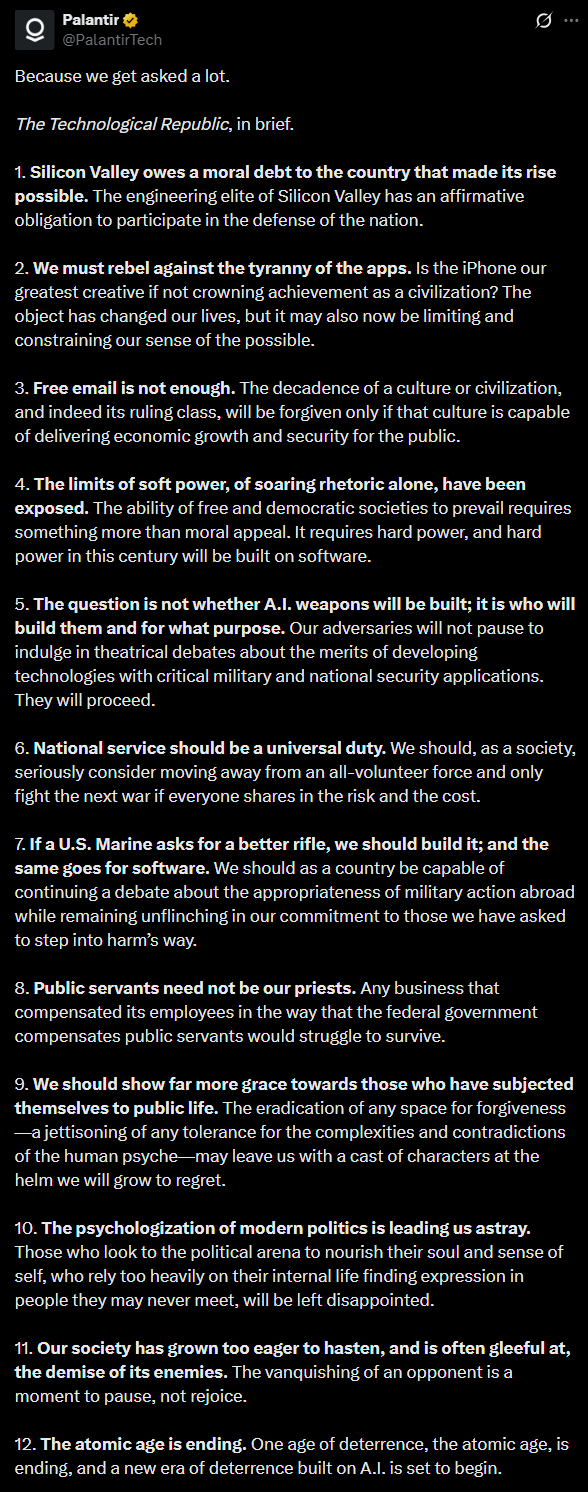
This post garnered support from individuals leaning towards the Right and Conservative ideologies, while concurrently attracting significant backlash. Numerous respondents criticized the post as an overreach for a tech company that should focus on developing software and services, rather than advising governments on leadership and global affairs.
Notably, Yanis Varoufakis, the former Greek finance minister and author of Technofeudalism, condemned it as “hideous ideology in 22 points” and a sales pitch demanding that the “West needs more of Palantir’s lethal software.”
The manifesto has caught the attention of individuals worldwide. For example, a Member of Parliament in Britain criticized it, suggesting it resembled a parody of RoboCop, a film where an augmented law enforcement officer assumes the roles of judge, jury, and executioner. “Palantir’s manifesto, which endorses AI surveillance of citizens alongside national service in the USA, is either a parody of a RoboCop film or a disturbing narcissistic rant from an arrogant organization,” stated Martin Wrigley, as reported by the Guardian.

In response, Palantir maintains that it is simply a technology company providing software and tech solutions. In a statement to the Guardian, it remarked: “That is all we are: a software company. How (our) tools are utilized is dictated by the customer, and constrained, legally, contractually, and technically, by their directives.”
However, this does not negate a crucial point: as AI continues to grant alarming power to governments and select corporations, Palantir may position itself as one of the most perilous entities globally. Its work, along with its guiding principles, could facilitate mass surveillance at an unimaginable scale. Given the apparent power of its systems, Palantir may endow an unprecedented level of authority to those who wield its tools, and whether these individuals will exercise restraint is uncertain.
To date, most tech firms, even those that manage substantial amounts of user data, have been content to use this information for targeted advertising. Companies like Google and Apple have also restricted themselves to commercial interests and maintained a neutral stance on many social and political issues. This is why when they choose to engage in controversial projects, even their own employees express concerns. In contrast, Palantir operates on a different model and possesses a distinct ethos. Its “manifesto” makes its position explicit. It represents a new breed of company that may usher in a more perilous and unforgiving world.