
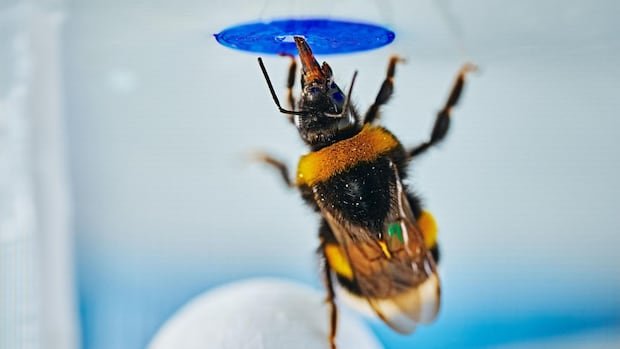

In a recent study led by scientist Juha-Heikki Kantola, bumblebees demonstrated remarkable problem-solving skills that left researchers astonished. The study, published in the journal Science, showcased how bumblebees were able to navigate a ball to access a sugary reward without any prior training.
Drawing inspiration from psychologist Wolfgang Köhler’s famous “box-and-banana problem” experiment with chimpanzees, the researchers designed a series of tasks for the bumblebees. The bees were trained to associate a blue circle on the floor with a food reward, and then challenged to retrieve the reward by pushing a ball underneath the circle and climbing on it.
Remarkably, 73% of the bees successfully completed the task, displaying a level of problem-solving ability typically associated with animals possessing larger brains. The bees’ spontaneous solution to the puzzle without prior exposure to such challenges impressed the researchers.
This study stands out as the bees were considered “fully naïve,” having no prior experience with the specific problem-solving tasks presented to them. The researchers emphasized that the bees’ ability to solve complex puzzles reflects their cognitive prowess, challenging traditional notions of intelligence limited to certain species.
The findings shed light on the cognitive capabilities of bumblebees and highlight their adaptability and problem-solving skills, both in controlled laboratory settings and in their natural habitats. Conservation biologist Amanda Liczner praised the study, noting that understanding bees’ remarkable abilities may lead to greater appreciation and conservation efforts for these essential pollinators.