
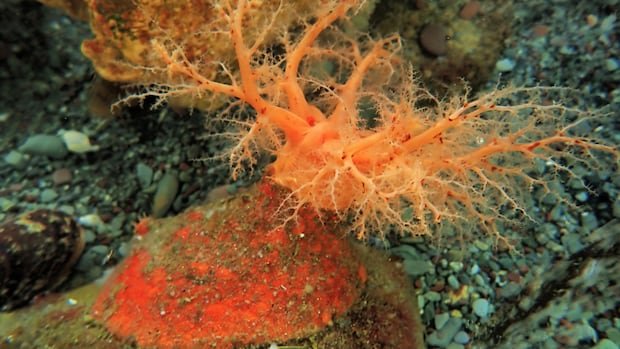

A recent discovery by a Canadian researcher reveals a fascinating phenomenon where severed tissue from scarlet sea cucumbers demonstrates a unique form of longevity, existing in a state between life and death.
Sara Jobson, a doctoral student at Memorial University in Newfoundland and Labrador, led the study that uncovered the apparent immortality of scarlet sea cucumber tissue. Describing their findings as observing “little lab zombies,” Jobson and her team noted this as the first documented case of tissue surviving independently.
Contrary to typical expectations of tissue death post-amputation, scarlet sea cucumber tissue, scientifically known as psolus fabricii, exhibits remarkable resilience in the North Atlantic Ocean. The study, detailed in Science Advances, involved placing segments of tentacles and tube feet in seawater to monitor their behavior.
The severed tissue displayed a unique process where it sterilized the amputation site, sealed the wound, and gradually transformed into round, translucent blobs with a red pigment nucleus over several years. Jobson highlighted that this tissue evolution did not lead to the regeneration of a new sea cucumber but instead formed a distinct biological entity that sustained itself without reproduction.
Although displaying characteristics of living organisms such as nutrient absorption and an active immune system, the tissue samples did not exhibit reproductive capabilities, leading to their classification as “zombie tissue.” Jobson pondered on the evolutionary significance of this phenomenon in sea cucumbers, emphasizing the blurred boundary between life and death.
Apart from the profound implications of this discovery, Jobson emphasized the potential for utilizing such resilient tissue samples in scientific research. She expressed gratitude for the freedom of inquisitive exploration facilitated by her research environment, spearheaded by Professor Annie Mercier of Memorial University.
As Jobson continues her investigations into these enigmatic blobs, she aims to unravel the mysteries surrounding their cellular aging processes. This groundbreaking research underscores the importance of fostering curiosity-driven scientific inquiry for uncovering novel insights in the natural world.