
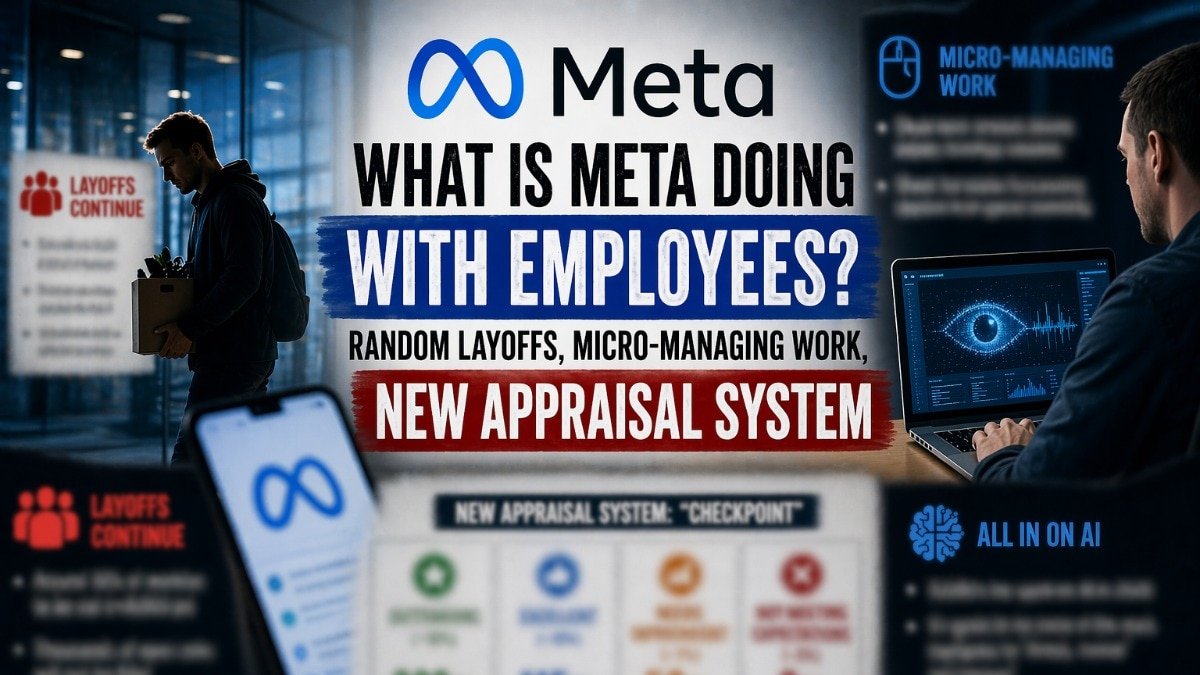

Meta is currently undergoing significant internal changes beyond just layoffs. Recent developments have seen employees facing unexpected job cuts, increased monitoring of their daily tasks, and a revamped appraisal system that offers both rewards and heightened pressure. These shifts provide insight into the company’s realignment in the era of artificial intelligence (AI).
The layoffs have become more frequent and widespread. In early April 2026, Meta revealed plans to eliminate approximately 200 positions in Silicon Valley, affecting locations in Burlingame and Sunnyvale. Prior to this, reports indicated that layoffs impacted teams in Reality Labs, social media divisions, and recruitment operations. Earlier in the year, Meta had already downsized around 10% of its Reality Labs workforce, affecting over 1,000 employees.
The most startling announcement came when Meta disclosed its intention to cut about 10% of its workforce in May 2026, equating to nearly 8,000 employees. Additionally, the company plans to leave approximately 6,000 vacant positions unfilled. While tech industry layoffs are not uncommon, the phased nature of the cuts at Meta has raised internal inquiries due to the absence of a singular, clearly defined restructuring plan.
Janelle Gale, Meta’s Chief People Officer (CFO), stated in a memo to employees that these changes are part of the company’s ongoing efforts to enhance operational efficiency and offset other investments being made, particularly in AI. This strategic shift towards AI investments has been a key driver behind the recent layoffs.
The company had previously stated that there would be no performance-linked layoffs in 2026, but this was contradicted by the subsequent layoff announcement in April. The reasons behind these layoffs, whether performance-related or otherwise, remain unclear and are expected to be clarified as the layoff process unfolds in the coming weeks.
At the core of these changes is Meta’s aggressive foray into AI. CEO Mark Zuckerberg had earlier indicated that AI would revolutionize internal workflows in 2026, enabling fewer individuals to handle tasks that previously required larger teams. Meta’s substantial investment of up to $135 billion in AI this year, equaling its cumulative spending on the technology over the past three years, underscores the company’s intensified focus on AI initiatives.
As part of this AI push, Meta has introduced a new monitoring system called the Model Capability Initiative (MCI), which tracks mouse movements, keystrokes, clicks, and screen snapshots during employee work hours. This system aims to enhance AI systems’ understanding of human-computer interactions and improve overall efficiency.
Employees are being encouraged to utilize AI tools in their tasks, with internal targets indicating that some teams are expected to utilize AI assistance for up to 75% of their coding work. The adoption of AI tools like DevMate and Google’s Gemini is closely monitored to gauge their widespread utilization and effectiveness.
In addition to layoffs and enhanced monitoring, Meta is revamping its employee evaluation process with the introduction of a new performance program called “Checkpoint” in 2026. This program features a four-tier rating system with varying bonus structures, incentivizing high performers with bonuses of up to 200% of their base pay and a select few with a special “Meta Award” offering a 300% bonus multiplier.
The revamped appraisal system aims to streamline the review process, reduce feedback time, and elevate the significance of AI-driven impact in employee evaluations. Meta is signaling a more competitive work environment, where AI-driven contributions will play a pivotal role in determining employee performance ratings.