
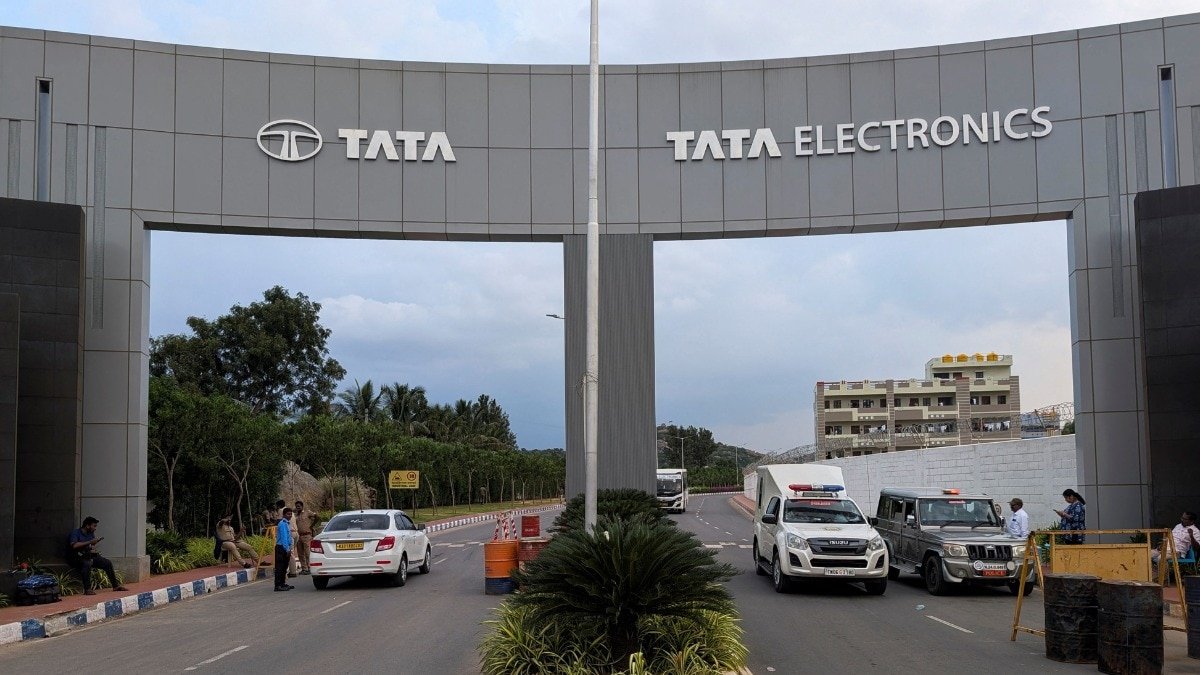

Tata Electronics has emerged as Apple’s largest contract manufacturing partner in India in terms of employees. Recent data from The Economic Times reveals that the company’s workforce has grown to approximately 75,000 employees, surpassing Foxconn, a major Taiwanese firm, in total headcount. This achievement by Tata is particularly remarkable due to the rapid pace of its expansion. Just two years ago, at the time of its agreement with Apple, Tata Electronics had only about 15,000 employees. Since then, its workforce has nearly quadrupled.
The significant growth at Tata Electronics has been primarily fueled by its expansive facility in Hosur, Tamil Nadu, as well as its acquisitions of Wistron and Pegatron’s operations in India. The company has been actively focusing on recruitment efforts to enhance its scale to meet the stringent requirements of Apple’s global supply chain and facilitate large-scale iPhone production.
While Tata Electronics currently leads over Foxconn, this position may be temporary as Foxconn is expected to boost operations at its upcoming plant in Devanahalli later this year, potentially reclaiming the top spot. Nevertheless, Tata Electronics’ rapid scaling in a sector traditionally dominated by established players from Taiwan, China, and South Korea is noteworthy.
Currently, Tata Electronics and Foxconn are the primary manufacturers of Apple products in India, supported by a growing component ecosystem. Tata Electronics has taken over Apple-related operations acquired from Wistron and Pegatron and now oversees significant iPhone assembly in Tamil Nadu and Karnataka.
Tata’s remarkable growth story began in 2020, and within a short period, it has developed capabilities that position it as a competitive player among global contract manufacturers. The company has attained a critical mass, enhancing its operational efficiency, supplier management, and ramp-up capabilities crucial for handling high-volume, precision manufacturing like iPhones.
Despite its progress, analysts suggest that Tata Electronics must expand beyond assembly and enhance its involvement in the value chain. This entails focusing on localization, improving quality and yields, and establishing resilience across multiple manufacturing sites. The company also aims to venture into semiconductor fabrication and advanced packaging in its upcoming growth phase.
India is steadily emerging as a significant hub for global electronics manufacturing, bolstered by a skilled workforce, favorable policies, and increasing localization efforts. Apple’s expanding presence in India has been pivotal to this transformation, with iPhones projected to be India’s top export by 2025, estimated at approximately $23 billion, primarily to the US.