
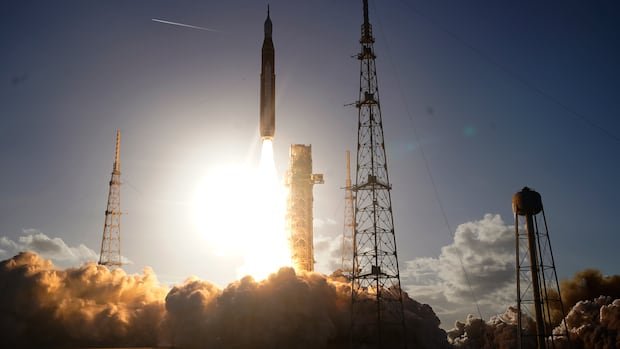


NASA’s Artemis program has attracted attention for its intention to send astronauts on a lunar orbit. However, beneath this mission lies a broader strategic competition: a new rivalry between the United States and China to land humans on the moon once again.
This contest goes beyond symbolic actions and mere footprints. The nation that accomplishes this feat first stands to secure an advantage in determining the location for future lunar infrastructure, establishing technical standards, and shaping the upcoming phase of space exploration.
During NASA’s recent Ignition event, officials highlighted this urgency explicitly. NASA is striving to land Americans on the moon before China does – and before the conclusion of U.S. President Donald Trump’s term.
Jared Isaacman, the billionaire nominated by Trump to head NASA, emphasized, “NASA has declared that we will return Americans to the moon before the end of President Trump’s term. Our main competitor has set a target before 2030.”
“The difference between success and failure will be gauged in months, not years.”
The competition is now in full swing, at least from a political perspective. NASA is formulating an expedited plan to achieve a lunar landing with American astronauts by early 2028, while Wu Weiren, the chief designer of China’s lunar program, has stated, “By 2030, the Chinese people will undoubtedly set foot on the moon. That’s a certainty.”
Casey Dreier, the chief of space policy at the Planetary Society, doubts the feasibility of the 2028 target. Nevertheless, he acknowledges that China has become a significant motivator for NASA and its supporters.
“This is not just a sprint like Apollo; it’s a marathon. The aim this time is not just to visit the moon but to establish a lasting presence,” stated Dean Cheng, a senior fellow at the Potomac Institute for Policy Studies and a seasoned expert on China’s space endeavors. Cheng added, “China has been cautious with its space program predictions but has consistently delivered on its commitments.”
This is why China’s 2030 objective holds weight in this context.
While some argue that both the U.S. and China are ultimately destined to reach the moon, the significance of timing cannot be understated. The urgency is driven not only by political considerations but also by geographical factors.
Both nations have expressed interest in establishing lunar bases near the moon’s south pole. Scientists and planners view this region as particularly valuable due to its permanently shadowed deep craters potentially containing water ice.
Dreier highlighted the importance of water on the moon, which could be utilized for various purposes such as drinking, producing breathable oxygen, and creating rocket fuel.
The race to secure the most advantageous lunar sites is in full swing, with the country that lands first likely gaining the first pick.
In light of the ongoing developments, it is evident that the stakes are high, and the competition is fierce. The moon’s south pole holds strategic value, not just as a destination but as a potential gateway to further space exploration endeavors.