
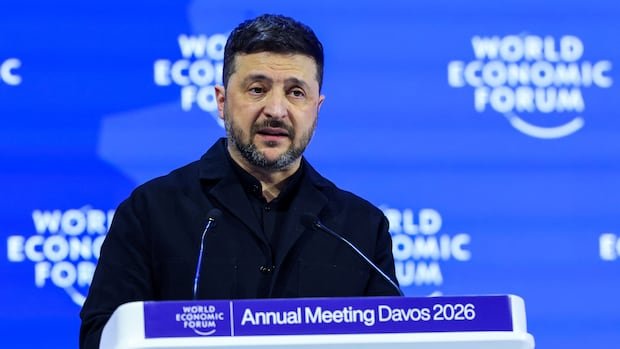

Ukrainian President Volodymyr Zelenskyy expressed disappointment with Europe’s handling of the Greenland conflict involving the U.S., urging the continent to exhibit more boldness and characterizing it as a collection of smaller and mid-level powers. Zelenskyy, delivering a passionate address at the World Economic Forum in Davos, Switzerland, criticized Europe for not taking a leading role in defending global freedom, especially in times when American priorities shift elsewhere.
He called on Europe to intercept Russian tankers carrying funds for the war against Ukraine, contrasting this with recent U.S. actions seizing oil-carrying ships from Venezuela. Zelenskyy emphasized the need for immediate action rather than just discussions about the future, questioning Europe’s inaction compared to President Trump’s proactive measures.
Following his speech, reports emerged that France’s navy, with intelligence from the United Kingdom, intercepted a suspicious oil tanker from Russia in the Mediterranean Sea, aiming to target the sanctioned Russian shadow fleet. This operation was carried out in accordance with international maritime laws.
Zelenskyy commended the operation on social media, emphasizing the importance of such resolute actions. He also highlighted upcoming trilateral meetings between Ukraine, Russia, and the U.S. in Abu Dhabi, stressing the necessity for compromises from all parties involved to achieve lasting peace.
In parallel, U.S. envoys engaged in talks with Russian President Putin, with discussions revolving around territorial issues and the pursuit of a diplomatic solution. Despite efforts for peace, challenges remain, including disagreements over boundaries and the status of Donetsk in Ukraine.
Zelenskyy’s domestic challenges were underscored by ongoing Russian attacks causing power outages and disruptions in critical infrastructure across Ukraine. Tragic incidents, including casualties and injuries, have occurred, highlighting the urgent need for a resolution to the conflict.
Overall, diplomatic efforts persist amidst complex geopolitical dynamics and humanitarian crises, signaling the ongoing struggle for peace in the region.