
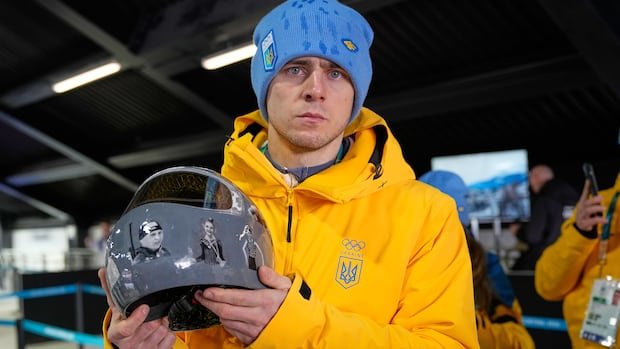

The Olympics have historically been a stage for political positioning, resulting in countries either abstaining or facing bans due to geopolitical disputes. However, the International Olympic Committee (IOC) asserts that political activities should cease once the games commence, ensuring that the competitions and victory podiums remain free from political “intervention.”
Determining what constitutes interference can be intricate. Despite the IOC’s recent decision to bar Ukraine’s Vladyslav Heraskevych for donning a helmet adorned with images of war victims, President Kirsty Coventry became emotional while justifying the ruling, acknowledging the helmet’s “powerful” message despite it breaching regulations. Heraskevych, a skeleton athlete, defied the IOC’s directive by showcasing Ukrainian athletes killed by Russia on his helmet, a nation excluded from the Olympics following its 2022 invasion of Ukraine.
Following the decision, there was an outcry from Heraskevych’s teammates, but an Olympic historian noted that the ruling aligned with a strict interpretation of the regulations. Bruce Kidd, a former Olympic athlete and University of Toronto professor emeritus specializing in sports history and political economy, remarked that the helmet served as both a tribute to fallen comrades and a clear political statement on the conflict’s nature.
Athletes are permitted to express political views outside competitive events and ceremonies, including press conferences and social media. Some athletes have taken advantage of this freedom, such as several American athletes who criticized their country with anti-ICE messages.
Heraskevych argued that the regulations were unfairly applied to him, citing instances like Israeli skeleton athlete Jared Firestone wearing a kippah bearing the names of Israeli athletes and coaches slain in the 1972 Munich Games. However, Firestone wore the kippah only during the Milano-Cortina opening ceremony, not during competitions.
The IOC instructed Haiti’s two-person team to remove an image of Toussaint Louverture, a key figure in the Haitian Revolution, from their opening ceremony jackets. Kidd emphasized that enforcing these regulations and defining political statements could be intricate and occasionally unclear.
The prohibition on political expressions dates back to the inception of the modern Olympics in the 1890s, envisioned by founder Baron Pierre de Coubertin to promote global peace and understanding. Criticizing another country’s politics was considered counterproductive to this objective. Nevertheless, some athletes have challenged these boundaries by subtly making political statements discernible to those familiar with the signs.
In notable instances, athletes like Irish track star Peter O’Connor and American sprinters Tommie Smith and John Carlos made impactful political statements at various Olympic Games, facing consequences ranging from retroactive downgrades to suspensions. While political gestures persist in recent times, enforcement of rules around political symbolism has been marked by contradictions over the years.
Kidd stressed that the Olympics are intended to embody liberal values and respect for all individuals, with the ban on political expressions aiming to prevent the incitement of hatred or conflict that could escalate international tensions. Governing the diverse world of sports while fostering respect and understanding amid global conflicts poses a significant challenge, especially in today’s climate of heightened tension and xenophobia.