
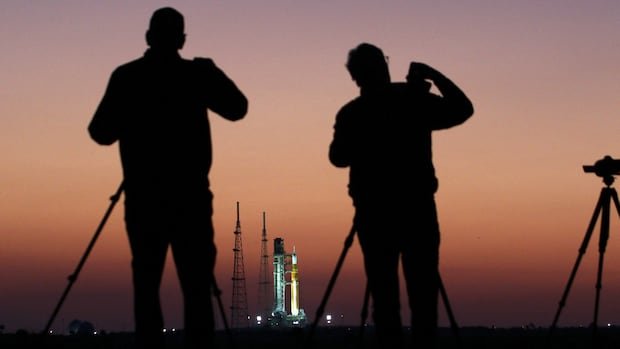


Artemis II is gearing up for its upcoming journey around the moon, poised to push the boundaries of human space exploration. The mission will see Canadian Space Agency astronaut Jeremy Hansen and NASA astronauts Reid Wiseman, Victor Glover, and Christina Koch aboard the Space Launch System (SLS) rocket and the Orion spacecraft, launching from Kennedy Space Center’s Launch Pad 39B in Florida.
The mission’s launch dates are subject to various factors like risk assessment and system readiness. Previous launch attempts in February and March were postponed due to technical issues involving hydrogen and helium. However, NASA has indicated an 80% probability of a successful launch on April 1, with the first launch window scheduled from 6:24 p.m. to 8:24 p.m. ET. Subsequent launch opportunities are available nightly from April 2 to April 6.
To achieve the necessary orbital trajectory for the lunar journey, the launch must occur at night, especially for East Coast viewers. Interested individuals can follow the detailed countdown minutes leading up to liftoff on NASA’s website.
CBC News will provide comprehensive coverage of the Artemis II mission, with on-site reporters delivering updates and reactions across radio, TV, and digital platforms. Viewers can tune in to CBC’s online coverage starting two hours before launch, including a live stream of the event and real-time updates.
While Artemis II will not land on the moon, it serves as a crucial test for systems with astronauts on board. The mission’s goal aligns with NASA’s broader Artemis program objectives of sustained lunar presence, scientific exploration, and economic activities, paving the way for future Mars missions.
NASA’s accelerated lunar exploration plans, including the establishment of a moon base and the reshaping of Artemis mission timelines, aim to reinvigorate American leadership in space exploration. The agency’s strategic adjustments respond to global competition, notably China’s advancements in lunar exploration, with ambitions to land Chinese astronauts on the moon by 2030.
Artemis II marks a significant step in NASA’s mission lineup, lasting approximately 10 days before the crew returns to Earth by splashing down in the Pacific Ocean.