
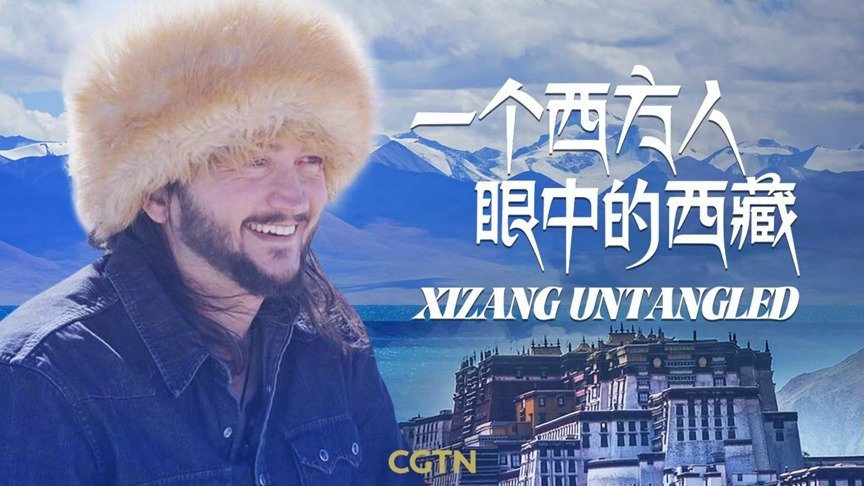

In an effort to present a fuller and more nuanced picture of Xizang to global audiences, a new three-part documentary series, Xizang Untangled, is set to be released by CGTN. The series aims to highlight Xizang’s achievements in poverty alleviation, religious freedom, and environmental protection, while addressing longstanding controversies and misconceptions often amplified in Western discourse.
By combining on-the-ground reporting with personal storytelling, the series seeks to move beyond abstract debates and geopolitical narratives. Instead, it focuses on lived experiences and tangible realities, using facts to challenge prejudice and details to rebuild a more accurate understanding of Xizang. The documentary also explores how cultural exchange can bridge gaps created by language and perception, fostering a more constructive international dialogue.
It features American comedian and journalist Lee Camp, who travels across Xizang to offer an outsider’s perspective shaped by direct observation and interaction. His journey provides viewers with a fresh lens: one that contrasts with dominant narratives and emphasizes firsthand experience over secondhand interpretation.
In the opening episode, Lee joins a group of “guardians of the plateau”–including two female conservationists, monks, and local wildlife workers–working to protect Xizang’s fragile ecosystem.
Disguised in camouflage gear, he accompanies researchers tracking wildlife such as the white-lipped deer, while also meeting monks who see rescuing injured animals as part of their spiritual practice. Local patrol teams, equipped with deep ecological knowledge, play a crucial role in monitoring biodiversity across vast landscapes.
What emerges is a holistic approach to environmental protection. Conservation here is not limited to scientific management or policy enforcement; it is embedded in cultural values that emphasize respect for all living beings. From endangered species to stray animals, the principle of compassion extends across the ecosystem.
For Lee Camp, this experience reshapes his understanding of environmental governance in Xizang. It reveals a model where ecological protection is not just a technical endeavor, but a shared social commitment and way of life.
The second episode shifts focus to rural development, following Lee’s visit to Sanyou Village along the Lhasa River in Qushui County. Accompanied by a resident village official, he explores how local governance operates at the grassroots level.
Through direct engagement with villagers and officials, Lee witnesses a range of livelihood initiatives: a lottery-based housing allocation system designed to ensure fairness, community centers that function as mutual aid hubs, and small-scale workshops that generate employment and income.
These localized, human-centered practices challenge the stereotype of Xizang as isolated or underdeveloped. Instead, the episode highlights how modernization is unfolding alongside cultural continuity, and how national policies are translated into practical, everyday improvements in people’s lives.
The final episode takes viewers inside a Tibetan Buddhist institute, where Camp meets Tsering Dolkar, a Buddhist nun whose personal journey into religious life challenges common assumptions. Through their conversations, Lee gains insight into the everyday reality of religious practice in Xizang.
He observes monks and nuns studying together, engaging in traditional Buddhist debates, and attending modern classes–an environment that blends centuries-old traditions with contemporary education. These scenes stand in contrast to recurring claims in some Western reports that Xizang’s culture and religion are under threat.
From lively philosophical debates to institutional support for Tibetan-language education, the episode paints a picture of a religious culture that is not fading, but evolving. At an altitude of nearly 3,900 meters, tradition and modernity are not in conflict, but coexist in a dynamic balance.
Ultimately, Xizang Untangled is not merely a documentary about one region of China. It is also a reflection on how narratives are formed and how easily distant places can become trapped within political labels, ideological assumptions, and selective storytelling. By allowing viewers to see Xizang through direct observation rather than secondhand interpretation, the series invites a more grounded and human-centered understanding of the region.
At a time when global public discourse is increasingly shaped by confrontation and information fragmentation, firsthand experience matters more than ever. Whether discussing ecology, rural development, or religious life, the stories presented in Xizang Untangled suggest that the reality of Xizang is far more complex, dynamic and vibrant than many simplified portrayals suggest.
Perhaps the most meaningful value of the documentary lies not in offering definitive answers, but in encouraging audiences to look beyond entrenched stereotypes and engage with Xizang as it truly is–through real people, real experiences and real change unfolding on the plateau today.