
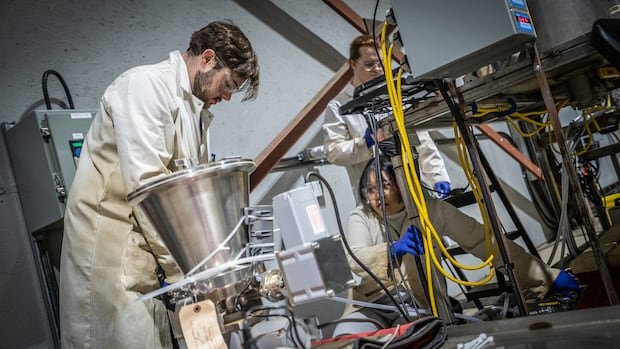

In Sudbury, Ontario, researchers are focusing on expanding bacteria-driven technology to extract valuable metals from old mine waste. MIRARCO Mining Innovation is operating a pilot facility to test the breakdown of mine tailings by microbes, releasing essential minerals like nickel, cobalt, and copper through bioleaching.
While bioleaching is widely used in international mining with around 30 sites globally, Canada has yet to fully implement this technology on a commercial scale, as stated by Nadia Mykytczuk, CEO of MIRARCO, the research division of Laurentian University. The 10,000-square-foot pilot facility in Sudbury was showcased to CBC recently, providing insight into the bioleaching process.
Mine tailings in Sudbury alone hold an estimated $8 billion to $10 billion worth of nickel. Despite the value of these materials, companies have hesitated to invest in reprocessing due to the high costs associated with sending tailings back to smelters. Typically, tailings are stored in large ponds, raising concerns about long-term environmental risks.
Jaime Kneen from MiningWatch Canada highlighted the risks associated with tailings, including potential chemical reactions that can lead to environmental contamination. The necessity to store tailings underwater poses stability concerns, as witnessed in the Mount Polley mine tailing dam collapse in 2014.
Both federal and provincial governments are urging the development of critical minerals to secure clean energy and national defense supply chains. Mykytczuk emphasized that bioleaching presents a dual solution by meeting the demand for critical minerals and aiding in mining remediation efforts.
The bioleaching process involves grinding tailings, mixing them with a liquid solution to feed bacteria, inducing chemical reactions that separate metals into a liquid form. The extracted metals are then collected after passing through a series of reactors. The remaining waste post-process is free from toxic materials and can be repurposed for construction or backfill in mining operations.
Researchers are also focusing on enhancing bacteria growth for bioleaching, targeting specific minerals found in mine waste. The team aims to transition from pilot testing to full-scale operations in Canada in the near future, aligning with global commercial bioleaching operations.