
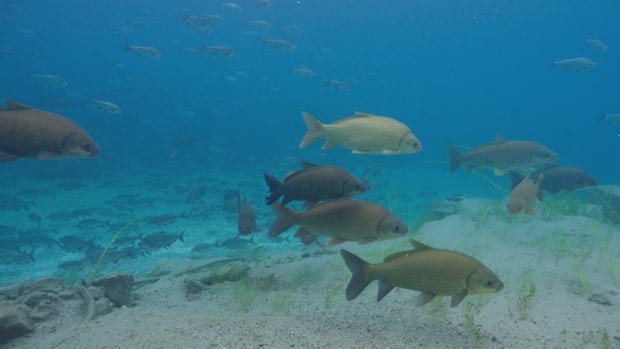

In Lake Huron, captivating underwater footage has revealed an apparent abundance of fish, leading a documentary crew to nickname a specific area “fish city” and feature it in honor of Earth Day. However, the Saugeen Ojibway Nation (SON) challenges this perception, asserting that the site near the Bruce Nuclear Generating Station is more akin to a “fish trap” than a thriving habitat.
SON highlights the significant death toll of up to five million gizzard shad in 2025, as reported by the Department of Fisheries and Oceans (DFO) in a Canadian Nuclear Safety Commission regulatory document. The mass mortality event occurred when an influx of fish obstructed the station’s cooling water intake systems, prompting the utility to shut down Bruce A Unit 2 as a precautionary measure.
Furthermore, SON emphasizes the plight of several lake sturgeon, an at-risk species of cultural importance in Anishnaabe traditions, which became stranded in a pond at the plant. While one sturgeon was successfully rescued by Bruce Power and SON, three others remain in the forebay pond.
The dispute surrounding the “fish city” designation extends beyond mere imagery, raising concerns about Bruce Power’s management of ecological risks as it seeks regulatory approval to enhance plant capacity for higher electricity production. The controversy underscores the need for stringent oversight and environmental stewardship in the operation of North America’s largest nuclear facility.
Despite regulators not attributing the fish die-off directly to the plant, Ryan Lauzon, a biologist affiliated with SON and the University of Toronto, conducted a comprehensive study on the incident. Lauzon’s research suggests that the warm-water outflow from the plant acts as a lure for fish, ultimately leading to their entrapment within the facility’s intake system.
Bruce Power rebuts allegations of causing the 2025 fish mortality, attributing the event to environmental factors such as elevated shad populations and severe winter conditions. The utility has implemented various measures, including nets and monitoring technologies, to prevent fish entrapment and enhance environmental safeguards.
In its quest to boost electricity generation, Bruce Power aims to increase output by approximately 11% by 2030 without constructing new reactors. The company asserts that the proposed power increase aligns with environmental standards and is essential to meet the growing demand for electricity in the province.
As the debate continues, the absence of clear benchmarks for assessing fish mortality in plant systems underscores the need for enhanced regulatory oversight and ecological monitoring. The ecological significance of gizzard shad, dismissed by some as “junk fish,” underscores the interconnectedness of species within the lake ecosystem and the cultural significance of fish in indigenous teachings.
The ongoing dialogue surrounding the “fish city” phenomenon underscores the delicate balance between energy production, environmental conservation, and indigenous cultural values. It highlights the imperative for responsible resource management and collaborative efforts to safeguard the ecological integrity of Lake Huron and its diverse aquatic inhabitants.