
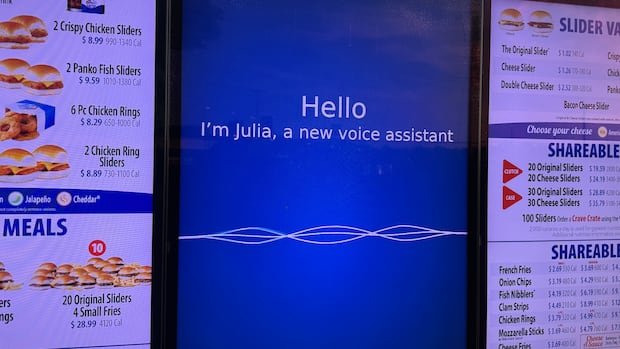

A bustling drive-thru in suburban Detroit appears typical until you approach close enough to discern the voice handling orders — which is not human but artificial intelligence (AI). Fast-food chains across the U.S. are increasingly adopting AI for their drive-thru operations, a trend that may soon extend to Canada. Companies argue that AI technology now surpasses human accuracy, although concerns exist among labor advocates about potential displacement of fast-food workers.
Although AI drive-thrus emerged as early as 2021, initial pilot projects encountered various challenges. Some customers deliberately tested the AI by requesting unusual orders, leading to viral incidents when the chatbot made errors or pushed upsells. As a result, companies reverted to human order takers. However, recent advancements in voice AI technology have propelled the rollout of chatbots at U.S. fast-food outlets. For instance, McDonald’s is experimenting with a Google-powered AI system, while Taco Bell has collaborated with Nvidia for chatbot implementation.
Two U.S. firms specializing in custom voice AI agents, Presto and SoundHound, anticipate the arrival of chatbots at Canadian drive-thrus in the coming months, although specific plans were not confirmed by several fast-food chains to CBC News.
One prominent example is White Castle, a U.S. burger chain that collaborated with SoundHound to develop an AI chatbot named Julia. This chatbot listens to customer queries and relays orders for staff preparation. In case of issues, an employee intervenes to ensure order completion. According to White Castle store manager Denise Harley, initial challenges were addressed, and the AI chatbot has significantly expedited order processing.
Customer feedback on AI drive-thrus at the Detroit White Castle varied, with some praising the convenience and accuracy, while others expressed skepticism about its efficacy. Despite not being flawless, the AI leverages generative technology to enhance its learning and performance over time. Jamie Richardson, White Castle’s chief marketing officer, highlighted the AI’s high order accuracy rate, surpassing previous levels.
White Castle has integrated Julia into around 40 locations, where the chatbot has effectively reduced drive-thru wait times and enabled employees to focus on other tasks. Richardson emphasized that the chatbot’s implementation aims to enhance productivity rather than reduce employment.
As the fast-food industry grapples with labor challenges like rising costs and turnover rates, AI adoption is positioned as a solution to address workforce gaps. SoundHound, the developer of Julia, asserts that AI technology can boost revenue by upselling to customers and enhancing operational efficiency.
Industry experts predict a widespread adoption of voice-enabled drive-thrus in the near future, with a focus on leveraging AI to streamline operations. Amid these advancements, concerns persist among labor advocates regarding potential job displacement, particularly impacting young individuals seeking entry-level positions. Siobhán Vipond of the Canadian Labour Congress emphasizes the importance of inclusive discussions involving governments, workers, and unions to ensure responsible deployment of AI systems in workplaces and safeguard worker interests.