
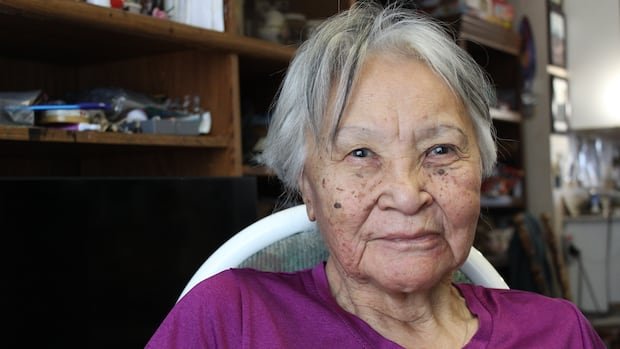

Millie Thrasher examines an orange Sallirmiutun dictionary at her residence in Paulatuk, N.W.T., indicating the translation of the term “mother” on page 80. She pronounces “Amaamak” out loud. Further down the page, she encounters the Inuvialuktun dialect’s expression for “he sent it by my mother,” which she struggles to repeat accurately in her language. “Some days, I find it challenging to recall a word and pronounce it correctly,” Thrasher admits. “If you don’t pronounce it properly, there’s no point in saying the word.”
Sallirmiutun is one of three Inuvialuktun dialects spoken by residents of the coastal N.W.T. communities of Paulatuk, Sachs Harbour, and Tuktoyaktuk. According to the N.W.T. Bureau of Statistics, around 411 individuals are able to converse in Inuvialuktun, with an estimated 200 speakers of the Sallirmiutun dialect.
Thrasher dedicates herself to practicing the language independently. “I am fluent in Inuvialuktun, and I cherish it. However, it is becoming more challenging as our elders are passing away and there are fewer speakers,” she laments. One of those who have passed away is Thrasher’s sister-in-law, with whom she used to practice pronunciations.
Lily-Ann Green, another elder from Paulatuk, believes there may only be three or four proficient speakers left in her community, possibly leaving Thrasher as the sole speaker. Both Green and Thrasher emphasize the importance of preserving the language. “I fear losing our language,” Green expresses. “It should be taught at home and in schools. Even incorporating a few words in our meetings would be beneficial.”
In Paulatuk’s Angik School, Sallirmiutun is taught to every grade, as confirmed by the school’s principal. Green mentions that she can understand Sallirmiutun but lost fluency in speaking it after attending residential school as a child. She is now in the process of relearning the language.
Nearly 360 kilometers west in Tuktoyaktuk, regular gatherings in a sod house have proven to be an effective method for teaching Sallirmiutun. Darrel Nasogaluak, the chair of the Tuktoyaktuk Community Corporation, notes that language classes have gained momentum in the last six to eight months, attributing the success to the venue. The sod house represents a traditional Inuvialuit dwelling, constructed using driftwood logs or whale bones as a frame and sod bricks for insulation.
Funding from the Inuvialuit Cultural Resource Centre supports the language classes in Tuktoyaktuk, where four instructors share teaching duties on Monday and Wednesday afternoons, attracting between four and ten participants. Nasogaluak observes that elders are now using the language in daily interactions, fostering communication and understanding among the community.
Middle-aged individuals, and occasionally younger people, attend the classes, providing hope for language revitalization. Nasogaluak expresses optimism, stating, “It’s really encouraging that I see some hope of language revitalization after a long time.”
Emily Angulalik, the executive director of the Kitikmeot Heritage Society, emphasizes the importance of spending time with fluent speakers to learn a language effectively. The society in Cambridge Bay, Nunavut, aims to revitalize Inuinnaqtun, an Inuit language spoken in various communities. Angulalik suggests connecting with elders for informal gatherings, similar to those in Tuktoyaktuk, or engaging in cultural activities like baking bannock to immerse oneself in the language.
In Paulatuk, Green and Thrasher advocate for more initiatives to revitalize Sallirmiutun within the community, underscoring the need to involve remaining elders in the preservation efforts. “We must seek the support of the elders still with us to reclaim our language,” Green asserts. Thrasher echoes this sentiment, emphasizing the importance of securing funding and maintaining perseverance in the pursuit of language revitalization.