

Oil prices increased while stock markets declined globally on Wednesday following U.S. President Donald Trump’s skepticism regarding the temporary truce with Iran. The S&P 500 dropped by 0.3% during the day, having fallen by as much as 1.1% earlier. The Dow Jones Industrial Average also decreased by 1.1% after Trump mentioned the end of the ceasefire agreement. Conversely, the Nasdaq composite, after initially declining, rose by 0.2% as Trump clarified that recent hostilities did not signify a return to full-scale conflict.
Canada’s primary index, the S&P/TSX, closed the day with a one percent decline. Notably, the oil market exhibited stronger activity, with the price of a barrel of Brent crude surging by 5.2% to $78.02 US around 4 p.m. ET, briefly surpassing $80 US. Although this remains below the peak seen earlier in the war when prices neared $120 US, the sudden increase is concerning as oil prices had only recently returned to pre-war levels.
Concerns persist that a prolonged conflict could result in the blockade of the Strait of Hormuz, impeding oil tanker movements in the Persian Gulf and disrupting global crude deliveries. This disruption could exacerbate inflation, which was anticipated to ease with lower oil prices, potentially prompting central banks to raise interest rates.
Rising rates may help contain inflation but could also dampen economic growth and impact various investment prices. On Wall Street, companies heavily reliant on fuel experienced significant declines, with American Airlines and cruise operator Carnival witnessing drops of four percent and 3.9%, respectively.
Stocks in the housing sector also contributed to the overall market decline, influenced by apprehensions of increased mortgage rates due to rising Treasury yields. Builders FirstSource, PulteGroup, and D.R. Horton saw declines of 5.4%, 5.4%, and 4.6%, respectively. Concurrently, certain influential stocks in the artificial intelligence industry stabilized, alleviating some of the downward pressure on the market.
Notably, Nvidia surged by 3.7%, exerting a notable positive impact on the S&P 500 due to its status as one of the largest stocks on Wall Street. In the bond market, Treasury yields mirrored the oil price increase, with the 10-year Treasury yield briefly approaching 4.60% before settling at 4.57%, up from 4.55% the previous day and significantly higher than the pre-war level of 3.97%.
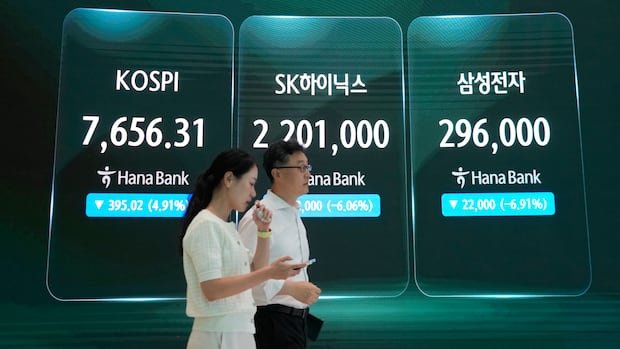
Internationally, European markets experienced exacerbated losses following Trump’s remarks on the ceasefire status, with Germany’s DAX and France’s CAC 40 both declining by 2.2%. In Asia, South Korea’s Kospi dropped by 5.3%, continuing its volatile trend driven by fluctuating sentiments towards AI stocks. Conversely, Hong Kong’s Hang Seng index rose by three percent.
In Hong Kong, shares of Chinese AI startup Zhipu, also known as Z.ai and traded as Knowledge Atlas Technology, surged by 13.4%. Notably, the share price of Zhipu has skyrocketed by more than 1,300% since its debut on the market in January.
This article was rewritten to enhance readability, maintain accuracy, and optimize for search engines.