
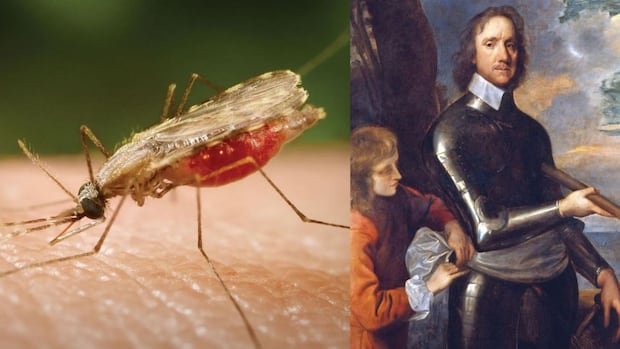

A council member in Cork, Ireland is pushing for the installation of a public statue commemorating a mosquito.
This proposed statue would not represent just any mosquito, but the insect believed by some in Cork to have bitten the English invader, Oliver Cromwell, causing him to succumb to what was once termed “Cork fever,” an old name for malaria.
If realized, this statue would likely be the “smallest public statue in the world,” according to Green Party councilor Oliver Moran, who shared his idea with guest host Nora Young on As It Happens. Moran envisions placing the miniature statue on an empty pedestal outside Cork City Hall, among other considerations he is exploring.
Moran recognizes that Cromwell’s legacy remains contentious, particularly depending on one’s perspective across the Irish Sea. In Ireland, Cromwell is remembered for brutal military campaigns during the 17th century that resulted in the deaths of hundreds of thousands in a bid to establish English dominance over the country.
Undoubtedly, Cromwell is not a revered figure in Irish history, which is precisely why Moran believes that commemorating his supposed insect assailant may resonate with many individuals.
Moran discussed with Young the inspiration behind his mission to honor this tiny creature. Here’s an excerpt from their conversation:
What prompted your idea to erect a statue in tribute to a mosquito?
The concept originated from an online discussion. Often, individuals studying Cromwell, primarily from an English viewpoint, would inquire about Irish perspectives on social media. I came across a post suggesting that the people of Cork should erect a statue to the midge believed to have bitten Cromwell, leading to his demise. I found this idea intriguing and fitting for a public monument.
Some individuals may be unfamiliar with Oliver Cromwell, while others may have been taught that he was a hero who contributed to the democratization of England and parliamentary supremacy. How is Cromwell perceived in your region?
There are indeed contrasting perspectives across the Irish Sea. In England, there exists a statue of Cromwell outside the British Parliament, where visitors might acknowledge his Irish campaign but without delving deeply into the historical context. In Ireland, however, he is associated with the Cromwellian campaigns that resulted in the deaths of hundreds of thousands, representing a starkly different viewpoint colored by violence and atrocities.
Can you provide a description of how you envision the statue?
At this early stage, we are exploring various possibilities, and I am pleased