
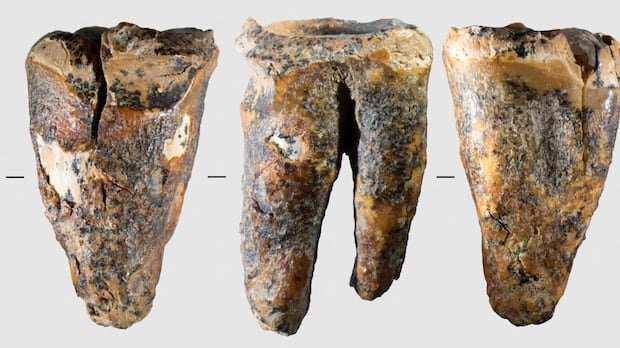

About 59,000 years ago, a Neanderthal residing in the Siberian mountains experienced a severe toothache and took action to address it. Recent findings reveal a lower molar in a cave at the base of the Altai Mountains exhibiting signs of dental treatment – a sizable hole that seems to have been manually drilled using a stone tool to extract decay.
The research, detailed in the journal PLOS One, identifies this as the earliest instance of invasive dental surgery, predating known cases of homo sapiens dealing with cavities. This contributes to mounting evidence suggesting that the long-extinct archaic human species possessed more sophistication than previously credited.
Anthropologist John Olsen, a study co-author, discusses the potential scenarios that led to this Neanderthal seeking dental assistance. Olsen suggests that the individual may have sought help due to unbearable pain or attempted self-treatment by using a stone drill to alleviate the discomfort.
While the concept of Neanderthal dentists is debatable, experts like University of Toronto paleoanthropologist Bence Viola propose that someone with experience likely conducted the procedure. The fossil, discovered at Chagyrskaya Cave in Russia, underwent detailed examination, revealing intentional modification rather than accidental damage.
Experimental studies using modern human teeth replicated the hole’s characteristics, highlighting the Neanderthals’ advanced cognitive abilities and deliberate medical strategies. This challenges the notion that such complex behaviors were exclusive to modern humans.
The study’s senior author, Kseniya Kolobova, emphasizes the Neanderthals’ sophisticated cognitive skills, including precise motor functions and strategic planning involved in the dental procedure. The findings depict a level of medical care that requires diagnosing, selecting appropriate tools, and executing precise drilling.
While uncertainties remain about the exact nature of the procedure, the study expands the understanding of early healthcare practices among Neanderthals. This discovery not only showcases their medical capabilities but also underscores the importance of communication skills within the ancient species.
Neanderthals, a species closely related to humans, became extinct around 40,000 years ago, with traces of their DNA persisting in the modern human population. Recent studies challenging traditional depictions of Neanderthals as primitive beings have highlighted their artistic endeavors, toolmaking skills, hunting techniques, cultural practices, and medicinal care for the sick and injured.
The significance of the tooth study lies not only in the potential medical expertise of Neanderthals but also in their ability to communicate complex ideas. Enduring a painful dental procedure without modern comforts suggests a level of understanding and communication beyond conventional perceptions of Neanderthals.