
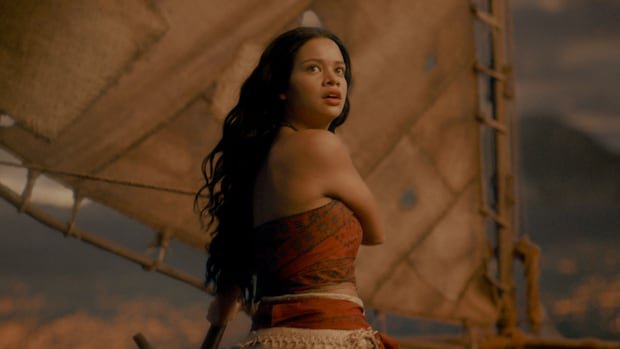

Disney’s latest live-action adaptation, “Moana,” has received harsh criticism for being visually unattractive and lacking creativity, much like previous remakes of animated classics. The film, a rehash of beloved source material, offers little new content and seems to exist solely for financial gain rather than artistic merit.
The story follows Moana, a Pacific Islander who defies her father’s orders to explore the sea to save her dying island. Teaming up with the shapeshifting demigod Maui, they embark on a journey of self-discovery and ancestral connection, set to the musical stylings of Lin Manuel-Miranda.
One notable addition to this rendition is an original song, “Along the Way,” placed in the end credits as a token gesture of creativity. However, this move has been criticized as a low-effort attempt to secure awards without integrating the song organically into the film.
The transition from animation to live-action has resulted in a less engaging visual experience, with CGI characters appearing out of place alongside live actors. The performances, while adequate, lack energy and are overshadowed by poor lighting and set design, making the film feel like a prolonged advertisement.
Despite its flaws, “Moana” remains watchable due to its adherence to familiar plot beats. However, the film’s lack of originality and reliance on nostalgia-driven storytelling have drawn ire from critics who believe audiences deserve better quality content. The film’s mediocrity should not be celebrated, and viewers are encouraged to demand more from the entertainment industry.
In conclusion, “Moana” (2026) is a prime example of uninspired filmmaking that prioritizes profit over artistic integrity, serving as a reminder of the repetitive and formulaic nature of Disney’s live-action remakes.