
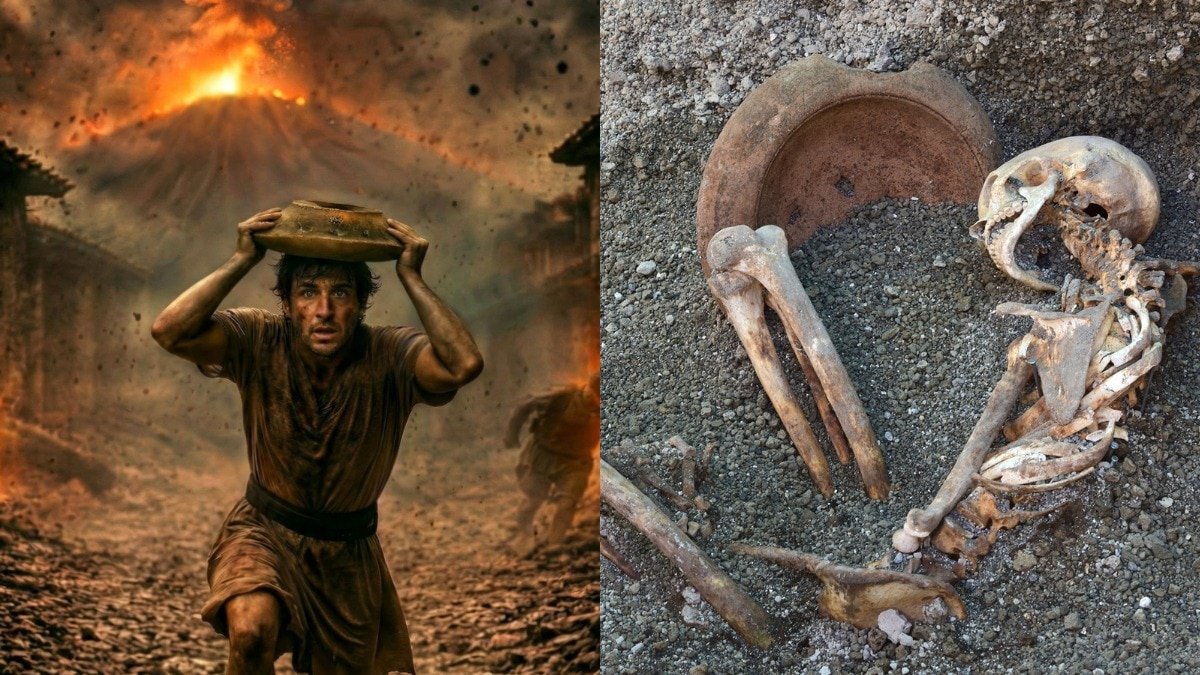

Nearly 2,000 years ago, the eruption of Mount Vesuvius led to the tragic burial of Pompeii, claiming numerous lives. While the historical account has preserved the memory of the victims, archaeologists at Pompeii have utilized artificial intelligence to provide a visual representation of one individual’s final moments.
In a groundbreaking effort, researchers have reconstructed the probable appearance of a man who was attempting to escape the eruption in AD 79. By transforming skeletal remains into a detailed image, they have portrayed a scene of survival and tragedy.
The AI-generated depiction, unveiled by the Pompeii Archaeological Park, portrays an adult male crouched forward, holding a large terracotta vessel above his head as volcanic ash and debris descended upon him. Against the backdrop of an erupting Vesuvius, the image conveys a sense of urgency and chaos.
It is essential to note that this visualization is not a photograph but a scientifically informed interpretation. Constructed based on excavation findings, skeletal analysis, and artifacts found near the body, the image captures the man’s final moments as he sought protection amidst the city’s destruction.
The remains were unearthed near one of Pompeii’s southern gateways, close to the Porta Stabia area and a necropolis beyond the city walls. It is believed that the man was making a desperate escape toward the coast on the eruption’s second day when he was tragically struck by volcanic material.
While additional remains were discovered nearby, the man’s posture and surrounding objects offer a vivid glimpse into his final moments. Besides the skeleton, archaeologists found a terracotta mortar, potentially used for grinding or mixing substances, suggesting the man used it as a shield against the falling debris.
Moreover, an oil lamp, a small iron ring, and ten bronze coins were also recovered, indicating that he fled hastily, grabbing only essential items within reach. These artifacts helped AI experts reconstruct not just his death but also his way of life.
The digital reconstruction was a collaborative effort with the University of Padua, merging archaeological data with advanced AI technologies to create lifelike visuals from physical evidence. Pompeii Archaeological Park’s director, Gabriel Zuchtriegel, emphasized that AI complements traditional archaeology by enabling better preservation and interpretation of vast archaeological datasets, leading to a revitalization of classical studies.