
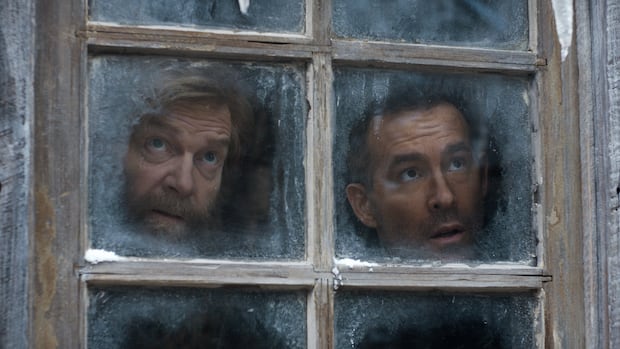

It’s peculiar that we continuously need reminders that other individuals are human beings, too.
You might even view it as a critique of our species, or simply a reflection of our time, that the concept of Mayday—a U.S. serviceman from the 1980s gradually realizing that a Soviet soldier possesses a personal inner life beyond merely devouring infants—holds any weight at all.
The narrative portrays it as difficult to accept that Nikolai (Kenneth Branagh), a seasoned ex-KGB officer, has benevolent motives for aiding U.S. navy pilot Troy (Ryan Reynolds) after Troy’s plane goes down near Nikolai’s remote cabin in the U.S.S.R. When he guides Troy through the chaos of Cold War gunfire and brutal punches out of compassion and selflessness, these traits are initially depicted as peculiar and foreign—especially coming from a Russian in 1987.
The story assumes that a sensible person wouldn’t take Nikolai’s heartfelt, America-loving rationale for shielding the injured Troy—who symbolizes the country he has come to admire—at face value. This skepticism is heightened by Nikolai’s own estranged daughter (Maria Bakalova) whom he is also trying to locate and protect, alongside a rogue KGB agent (Marcin Dorociński) and his clandestine group of merciless assassins who are pursuing them.
Are viewers truly expected to believe that Nikolai’s actions stem solely from his affection for America and a desire to defect, rather than being part of a complex scheme to infiltrate and undermine that metaphorical shining city on a hill?
It’s somewhat embarrassing, albeit not surprising, that the remainder of the film unfolds to demonstrate to down-to-earth American Troy that individuals from other countries can be just as sincere, multifaceted, and conscious as he is.
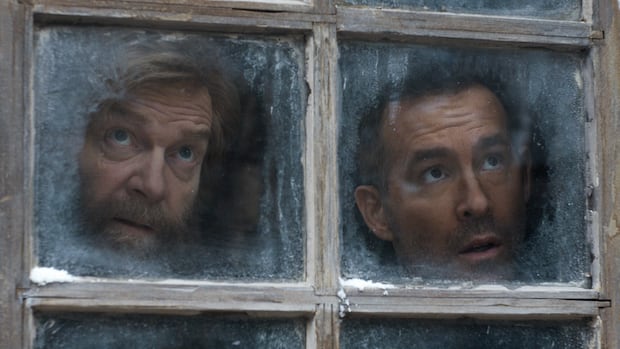
Kenneth Branagh and Ryan Reynolds deliver standout performances in the action comedy Mayday, according to CBC film critic Jackson Weaver: Branagh as the charmingly kind ex-KGB operative, and Reynolds as the U.S. navy pilot caught behind enemy lines in the U.S.S.R.
Mayday and similar films are only effective if we acknowledge that it makes implicit sense to not only harbor animosity towards anyone different from ourselves, but to initially perceive those individuals as barely human.
This makes it even more challenging to confess that Mayday truly succeeds.
It’s a guns-blazing, mismatched buddy comedy that boasts more style than it arguably needs, and showcases both actors in remarkable form: Branagh as the congenially lethal operative, and Reynolds as the straight-man counterpart struggling to keep pace and stay clear of the mayhem.
Crucially, there’s just enough chaos to complement its humor—and not so much that it becomes tiresome. Positioning Reynolds as the wisecracking sidekick is always preferable to films that make his Deadpool-style, tongue-in-cheek humor the focal point.
When those smug, self-satisfied quips come from a jaded side character in Adventureland, they are both charming and revealing. However, when The Adam Project revolves entirely around sarcastic humor, it quickly encounters the pitfalls of diminishing returns.
Naturally, this is not the first occasion a director has achieved the right balance for Reynolds.
In reality, Mayday feels like a perfect blend of his 2015 tragicomic road trip film Mississippi Grind featuring the melancholic Ben Mendelsohn, and his straightforward 2012 thriller Safe House alongside Denzel Washington as a similarly unnerving espionage figure.
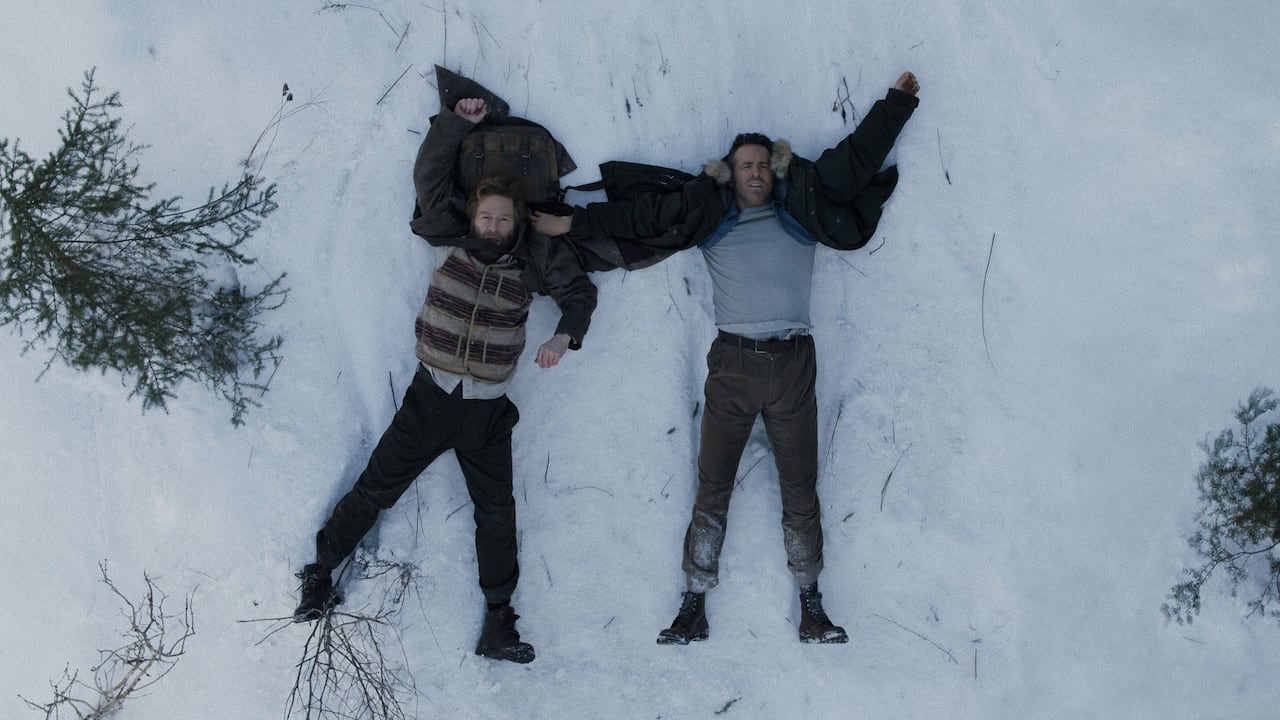
Branagh, left, and Reynolds both shine in Mayday: Branagh as the kindly lethal operative, and Reynolds as the straight-man counterpart striving to keep pace. (Apple TV)
Mayday directors Jonathan Goldstein and John Francis Daley navigate the same narrative currents; not only does Branagh occupy a wise, moderating role, but the camera reflects this as well. For every intense, bloody bar brawl we witness, we are also treated to largely extended, steady shots.
The camera flows through the chaos as unperturbed and confident as Nikolai himself, gliding almost leisurely around a calm Branagh as he relieves a man of the burden of having an intact face devoid of vodka bottle shards.
This showcases an impressive example of “less is more” filmmaking—almost the complete opposite of the frantic editing now prevalent in even contemporary Oscar-winning films. Instead, this cinematography resembles the “slow is smooth, smooth is fast” martial arts technique that Nikolai himself employs to incapacitate his opponents.
However, the overall outcome remains mostly straightforward and superficial; a film akin to Olympus Has Fallen from the Reagan era. Furthermore, the uplifting message at its heart only resonates if the notion that “people in Russia are human beings too” isn’t so absurdly obvious that it verges on offensive.
Yet, it’s hardly the first work of popular culture to explore that moral. Recently, Netflix’s Stranger Things played on the trope, reflecting ’80s trends from heartfelt films like Moscow on the Hudson to the more simplistic Russkies.
When they succeed, it’s because they evoke a vicarious thrill of dramatic irony—how ridiculous it seems that people once held such beliefs—or when they recognize their role as propaganda.
And indeed, they are propaganda; it would be difficult to find a mainstream Western film that portrays both America and Russia without casting one as fundamentally good with minor flaws, and the other as a nightmarish wasteland with a few morally (albeit emotionally hollow) resistors as exceptions.
-
REVIEW
The only time The Dog Stars isn’t boring is when it’s bad
-
REVIEW
Insidious: Out of the Further swaps sadness for terror. Then forgets to terrorize
This isn’t to imply that propaganda equates to poor filmmaking—quite the opposite. Beyond its military might, American cultural exports serve as their most potent weapon; one that has subdued more nations than anything else in their arsenal.
However, they can also reflect a furious, self-righteous jingoism—the kind of singular chosen-one narrative that birthed the disturbingly formidable, righteous violence of Red Dawn. Or they can present the narrative in such a way that even Russians find themselves rooting for America in Rocky IV.
Nevertheless, if there’s one commendable aspect of Mayday, it’s that it possesses at least a faint awareness of its role within that framework—and America’s as well.
Throughout the film, there’s a dynamic exchange between Nikolai and Troy regarding the propaganda they have been fed. Both sides are depicted with corrupt and ineffective politicians who fail their constituents. While there are certainly more severe violations of rights committed by the Soviets, the film does not engage in a blanket condemnation of one side or a total vindication of the other.
Overall, it sets a rather modest standard. However, Mayday manages to surpass it, leading to a mainstream American blockbuster that at least hints at the ambiguity of good and evil during the Cold War.
It may not be significant, but it makes one thing evident: The real shock isn’t in uncovering the humanity of the adversary, but in our belief that we are somehow distanced from it.