


After the inaugural FIFA World Cup 2026 match in Vancouver, Australian goalkeeper Patrick Beach was not captivated by the crowd or the atmosphere — instead, it was the quality of the grass that impressed him.
“The pitch was fantastic tonight, especially with the moisture. The ball moved exceptionally well,” Beach remarked to The Canadian Press following the June 14 match against Turkey.
“When we arrived and inspected the pitch… everyone was thrilled; they thought it was quite impressive.”
Hearing this, John Sorochan felt a surge of joy, as the field had been prepared for years through extensive research and testing to meet FIFA standards. Sorochan and his team were responsible for overseeing the grass installation and maintenance for all 16 World Cup venues, located in three different countries.
“It involves significant effort, countless hours, and many sleepless nights,” Sorochan, a distinguished professor at the University of Tennessee originally from Calgary, explained to Day 6 host Brent Bambury.

John Sorochan is a distinguished professor of turfgrass science and management at the University of Tennessee. (Steven Bridges/University of Tennessee)
Extensive testing
Alan Ferguson, FIFA’s senior pitch manager, approached Sorochan with the task of creating the fields for the World Cup during a meeting over tea and biscuits in London.
Sorochan accepted the challenge, and his team at the University of Tennessee collaborated with Michigan State University to tackle this significant project, which spanned the last five years.
Initially, the researchers examined the energy and impact of the ball as it struck the turf to ensure the field met the necessary specifications.
“We aimed for the ball to neither bounce excessively high nor too low off the surface,” Sorochan stated.
To achieve this, they utilized a training machine normally employed by goalkeepers for practice. This time, they launched soccer balls at an angle onto the grass, using high-speed cameras and radar technology to monitor the speed and angle of impact, as well as the ball’s velocity and trajectory after bouncing.
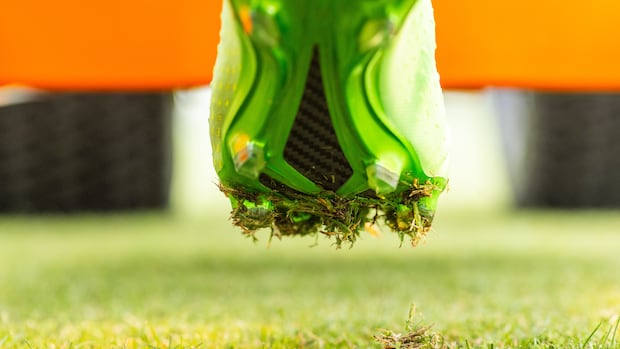
They also developed a machine featuring a 3D-printed foot, equipped with a cleat, to evaluate how the turf would withstand player movements. This apparatus also simulated the weight of a 172-pound soccer player, the average weight of athletes from the previous two World Cups.
Experiments were conducted under various conditions, with the grass maintained at different cutting heights.
Grass tailored to unique stadium requirements
All this was done to ensure consistency, particularly because this World Cup, co-hosted by Canada, the U.S., and Mexico, presented additional complications. The grass type required for an indoor venue in one region differs significantly from that needed for an outdoor venue in another area, yet they all needed to provide a similar feel.
According to Sorochan, indoor venues utilize a blend of 70% Kentucky bluegrass and 30% ryegrass, which are commonly found in residential lawns, cemeteries, and sports fields. Conversely, the outdoor stadium in Miami, for instance, requires Bermuda grass.
These grass varieties necessitate different management strategies, including varying mowing heights. It is crucial that they get it right, Sorochan emphasizes.
“We want to ensure that when a team plays in Miami and then travels to Boston or Toronto, the ball performs similarly, as if they were in the same stadium,” he noted.
Some of the grass, including that at B.C. Place in Vancouver, was cultivated in British Columbia by Bos Sod Farms in Abbotsford.
Detailed maintenance plan
Now that the fields are in use, they are no longer under Sorochan’s supervision. Each stadium, including B.C. Place in Vancouver and Toronto Stadium, has dedicated teams responsible for turf management.
This management includes advanced irrigation, a UV-light system, and a workforce of up to 50 people to maintain the grass.
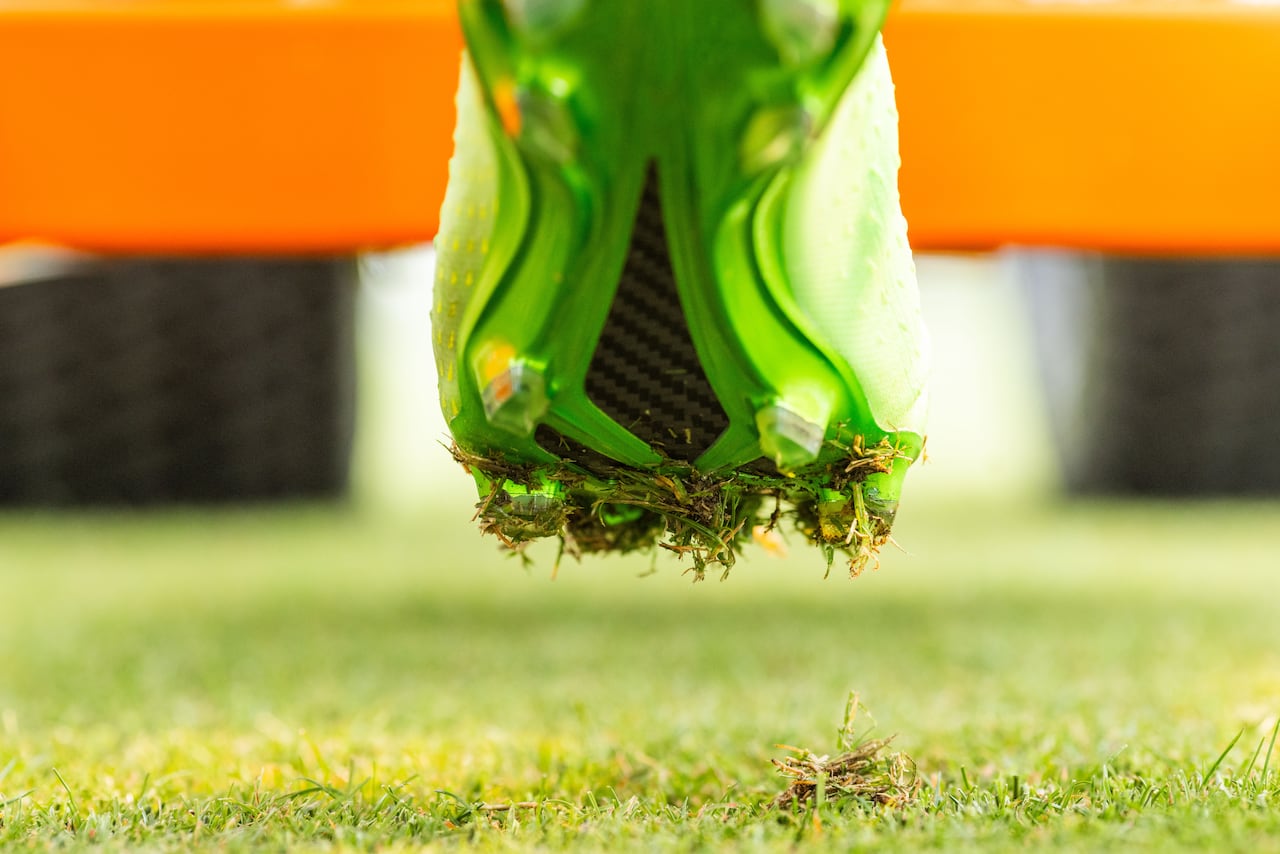
A detail of cleats on a shoe after it has struck turf as part of a flex machine demonstration. The machine is used to test the quality of the turf. (Steven Bridges/University of Tennessee)
“When people see this turf, they might think, ‘Oh, it’s just grass.’ But it’s far more than that,” stated Tony Valante, infrastructure manager at B.C. Place in Vancouver, to CBC News.
The field features a built-in vacuum system for moisture control. During intervals between matches, the maintenance crew works diligently on mowing, repairing, and watering the field. At B.C. Place, grow lights are also installed since the grass does not receive natural sunlight.
With the matches currently taking place and the grass now managed by others, Sorochan can largely relax and take in the praises from some of the world’s top soccer players.
“If players mention the pitch, it’s typically because they slipped or there was an issue,” Sorochan remarked.
“However, so far during this World Cup, we’ve heard players say it’s the best surface they’ve ever played on… it gives me goosebumps.”