
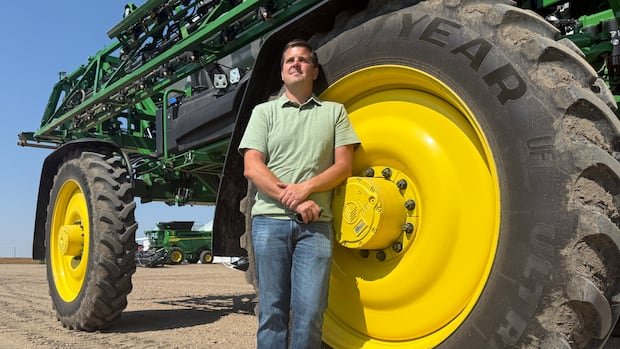

In Coleville, Saskatchewan, Dean Roberts observed a large grey drone flying over his expansive 4,000-hectare farm, where various crops such as canola, wheat, barley, and lentils are grown. The drone, known as the DJI T100, is the largest spray drone available in Canada, equipped with a 100-litre tank for spraying pesticides on crops. This practice was recently approved by the federal government.
During a demonstration, the drone’s tank was filled with water as it maneuvered through the fields. Roberts discussed how this innovative technology could benefit his farm, especially during wet conditions that make it challenging for ground rigs to navigate the fields. He highlighted the potential of drones in applying fungicides to combat leaf disease pressure in such situations.
Roberts emphasized that the drone represents the continuous technological advancements adopted by Prairie farmers to enhance crop yields. However, he noted that Canada lags behind countries like the U.S., China, Brazil, Japan, and Australia in permitting drone spraying activities due to regulatory constraints.
Infrastructure and labor shortages are additional hurdles faced by farmers like Roberts. He pointed out the importance of efficient transportation systems for exporting crops globally. Roberts highlighted the reliance on railways to transport crops to tidewater and the challenges posed by delays in the transportation network.
Evan Shout, co-founder of Maverick Ag, echoed Roberts’ concerns, emphasizing the impact of infrastructure issues on farming operations. He stressed the need for farmers to have a voice in decision-making processes and highlighted the complexities of finding skilled labor for agricultural tasks.
In response to these challenges, Agriculture Minister Heath MacDonald highlighted government initiatives to address obstacles hindering agri-food exports. He mentioned investments in critical infrastructure projects and support for strategies like the Vancouver Gateway Strategy.
The discussion also touched on the broader goal of boosting exports within Canada’s national food security strategy. Jennifer Clapp, a professor at the University of Waterloo, emphasized the importance of sustainable agricultural practices and cautioned against solely focusing on export expansion without considering broader implications.
Looking ahead, Evan Fraser highlighted the potential for Canada to become a significant agricultural power amid changing global dynamics. He emphasized the need for proactive measures to position Canada as a key player in food production and exports.
Dean Roberts expressed optimism about Canada’s ability to contribute significantly to global food production given its vast arable land and favorable climate for farming. He acknowledged the challenges but remained confident in Canada’s potential to make a significant impact in feeding the world.