
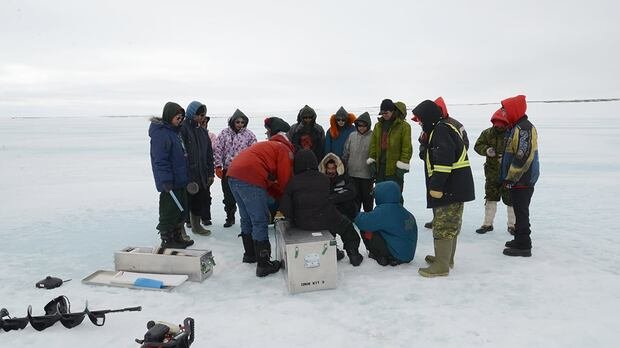

Candice Sudlovenick finds fulfillment in her role as an outreach programs manager at SIKU. Over a decade ago, she engaged with Ikaarvik as a young participant, an experience that sparked her passion for research. Reflecting on her time with Ikaarvik, Sudlovenick expressed how empowering it was, highlighting the realization that her voice mattered and was valued.
In a recent publication in Arctic Science, the discussion revolves around the methods of Inuit leadership in research. The paper, co-authored by Danielle Nowosad, a postdoctoral fellow at the University of Calgary of Métis descent, sheds light on the increasing emphasis on the inclusion of Indigenous perspectives and knowledge within Canada.
The formation of Ikaarvik stemmed from a group of Inuit youth who completed the Environmental Technology Program at Nunavut Arctic College in Pond Inlet in 2010. Their aim was to extend their environmental work beyond the classroom. Ikaarvik, aptly named, aims to transform obstacles into opportunities by preparing Inuit youth for careers that bridge traditional Inuit knowledge with scientific research.
Sudlovenick emphasized the importance of reshaping historical research relationships with communities, advocating for the recognition of Inuit capabilities beyond traditional roles. Nowosad highlighted the prolonged efforts of Inuit communities to secure meaningful involvement in research, emphasizing the compatibility between Western science and Inuit Qaujimajatuqangit (IQ), traditional knowledge rooted in Inuit heritage.
Despite improvements in collaboration, challenges persist in research endeavors. Nowosad pointed out the discrepancies between the timelines and expectations of academic institutions and the time required to cultivate robust community partnerships. The mismatch between fast-paced academic outputs and the deliberate nature of community-based work poses a significant hurdle.
With the escalating impact of climate change in the Arctic, the significance of local knowledge is increasingly recognized by both researchers and community leaders. Sudlovenick underscored the importance of valuing Indigenous knowledge on par with Western science, emphasizing its potential to inspire and empower youth in northern communities. The convergence of technology and traditional knowledge among younger generations signals a promising trend towards bridging the gap between Western science and Inuit Qaujimajatuqangit.