
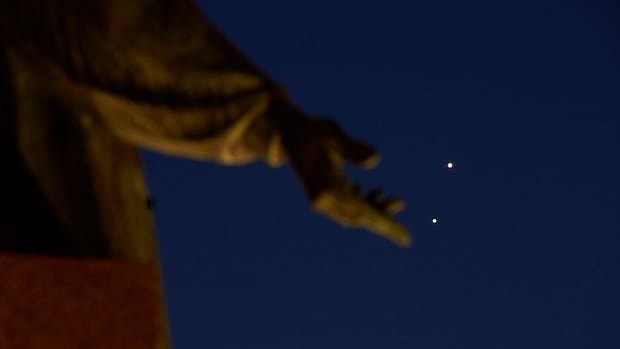

In the western sky after sunset, two bright celestial objects catching your eye are not stars but the planets Jupiter and Venus. Despite appearing close in proximity, they are actually approximately 670 million kilometers apart. Venus has been ascending in the sky since May, while Jupiter has been descending westward.
Observing the pair post-sunset in the western direction, Venus, shining brighter and lower on the horizon, can be easily spotted. These planetary conjunctions serve as a tangible reminder that space is in constant motion.
Paul Delaney, an emeritus professor at York University’s Department of Physics and Astronomy, emphasized the fascination generated by the two brightest planets in the evening sky, which showcase the dynamic nature of celestial bodies in our solar system.
As the days progress, Venus will surpass Jupiter, moving higher in the sky. On June 8, the planets will be slightly over a degree apart, with an even closer alignment on June 9. These celestial rendezvous are technically termed appulses but are commonly known as conjunctions.
One does not need to wait for the closest approach to witness this astronomical event. Tracking their movement across the sky in the upcoming days only requires a clear view of the western horizon.
Additionally, Mercury will join the planetary pair on the evenings of June 8 and 9, becoming more visible as it emerges from the sun’s glare. Delaney highlighted that planetary conjunctions occur annually, varying in proximity and brightness.
Although Jupiter and Venus align approximately every three years, their evening conjunctions are not always guaranteed. An intriguing prelude to the conjunction is observing Jupiter’s moons shift positions from night to night.
Jupiter’s four brightest moons – Io, Callisto, Europa, and Ganymede – orbit the planet rapidly, allowing their positions to change visibly within a single night. Utilizing tools like Sky & Telescope’s Jupiter Moons tool or night sky apps can aid in identifying these celestial objects in the sky.