
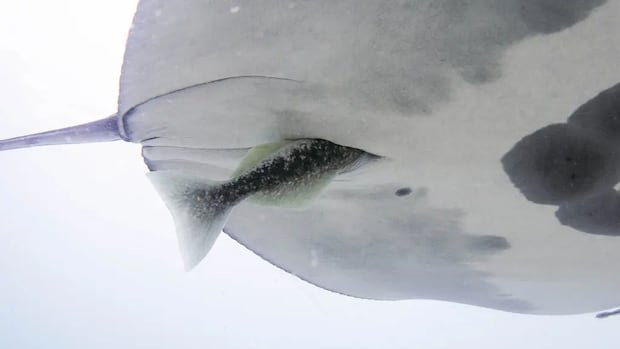

Marine researcher Emily Yeager shared insights in a recent interview about an intriguing behavior observed in suckerfish, also known as remoras. These small fish hitch rides on larger marine animals like manta rays, sharks, and whales, feeding on parasites in exchange for transportation. However, new research indicates potential discomfort for manta rays due to remoras’ behavior.
Yeager, a marine researcher at the University of Miami, highlighted a phenomenon termed “cloacal diving,” where remoras enter the cloaca of their hosts, a multi-purpose orifice for reproduction and waste elimination. While such behavior has been witnessed with whale sharks previously, the study by Yeager and her team presents the first documented evidence of this interaction between remoras and manta rays.
The study documented seven instances of cloacal diving over 15 years in various ocean locations, suggesting a potentially underreported occurrence. Yeager explained that remoras might exhibit this behavior as a response to fear, as seen in a video where a startled remora swiftly enters a manta ray’s cloaca.
Brooke Flammang, a biological sciences professor, suggests that the remoras’ actions may stem from a quest for food, a behavior known as coprophagy. Flammang, who has researched remoras but was not involved in this study, emphasized that such behaviors are not uncommon for these peculiar fish.
While it remains uncertain how manta rays perceive this invasion of their cloaca, Yeager expressed concerns about potential harm caused by remoras’ suction cups. Skin damage from the fish could impact the sensitive cloaca, potentially affecting reproduction and waste elimination processes over time.
Yeager highlighted the complexity of the relationship between remoras and manta rays, challenging the traditional categorization of symbiotic or commensal relationships in nature. She suggested that such interactions likely exist on a spectrum, reflecting the nuanced nature of relationships in both wildlife and human contexts.